A Melbourne-based retailer selling outdoor gear had a clear goal: move from a basic social media presence to a fully functional online store. After receiving quotes ranging from $5,000 to $80,000 and timelines from four weeks to six months, the business owner found it impossible to compare offers. Every developer described “ecommerce website development” differently, and no one explained why the same platform choice could produce such wildly different numbers.
This confusion is common across Australia, where ecommerce development costs vary based on platform selection, feature complexity, integrations, and the type of provider. Understanding what drives both cost and timeline is the difference between a project that stays on track and one that drifts into unexpected expenses and delays.
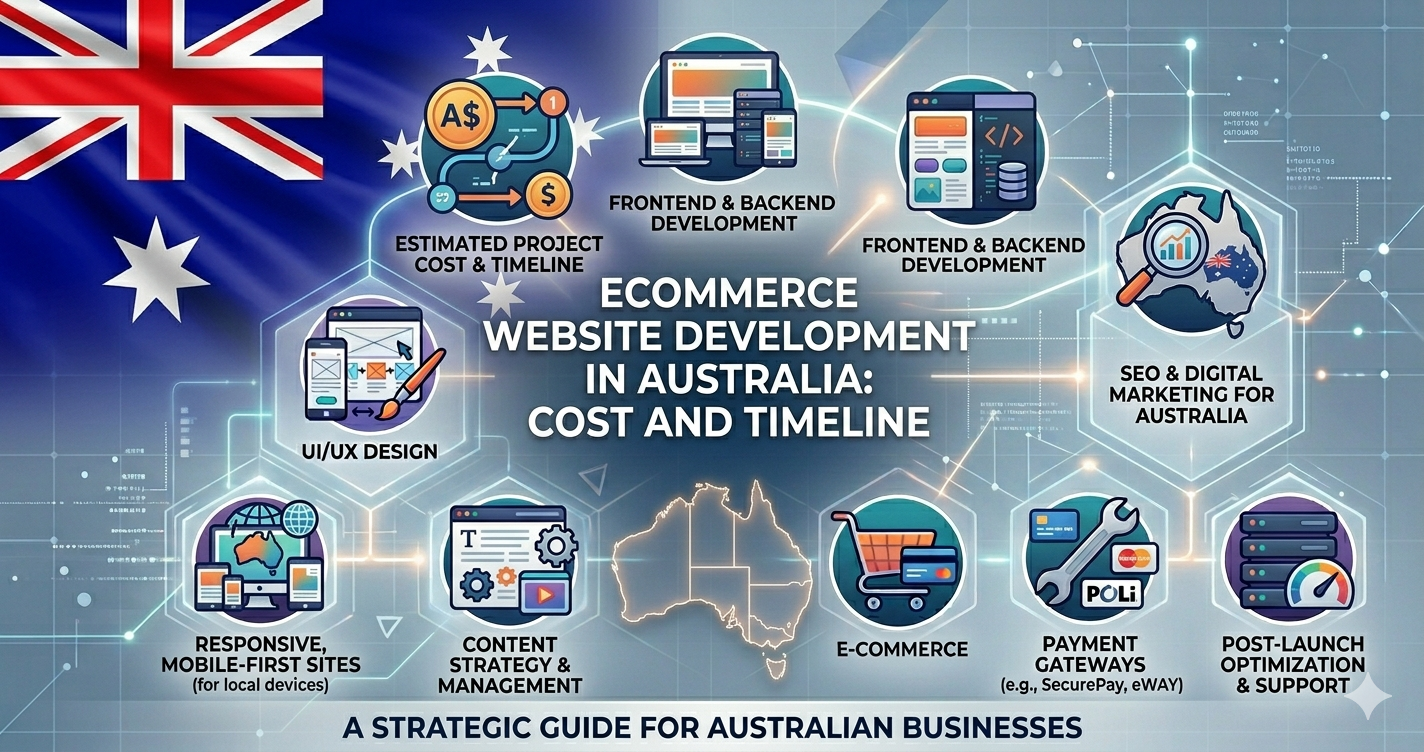
This article breaks down the real-world cost and timeline components of ecommerce website development for Australian businesses. It examines how platform choices, custom functionality, payment gateway requirements, and local factors like GST and shipping zones influence the final numbers—and helps decision-makers ask the right questions before signing a proposal.
The single biggest factor affecting both cost and timeline is the ecommerce platform. Each platform imposes different constraints and development approaches.
Shopify is the most common entry point for Australian small to medium businesses. Development costs typically run $3,000–$10,000 for a standard store using a premium theme with moderate customisation. Timeline: 4–8 weeks. The platform includes hosting, security, and payment processing, which reduces ongoing complexity but comes with monthly fees and transaction costs.
WooCommerce (WordPress) offers greater flexibility and lower recurring costs but requires more hands-on setup. Development costs range from $5,000–$15,000 for a similarly featured store, with timelines 6–10 weeks. The trade-off is more control over data, lower transaction fees, and easier content marketing integration—but the business must manage hosting, security updates, and performance optimisation.
BigCommerce sits between Shopify and WooCommerce in terms of features and pricing. Development costs $6,000–$12,000, timeline 6–10 weeks. It is often chosen by businesses with complex product catalogues or multi-channel selling requirements.
Custom development (Laravel, React, etc.) becomes necessary when off-the-shelf solutions cannot accommodate unique business logic (e.g., complex rental models, B2B portals, custom ERP integrations). Costs start at $20,000 and can exceed $100,000, with timelines 12–24 weeks. This path is rarely justified for standard retail operations.
The platform decision should be based on the business’s long-term needs, not just upfront cost. A Shopify store that requires significant custom app development may end up costing more than a well-architected WooCommerce build.
Beyond the platform license or base development, several elements contribute to the total cost of ecommerce website development.
Australian businesses typically integrate:
A realistic timeline for ecommerce website development spans several phases, each with its own dependencies.
| Phase | Duration | Key Activities |
| Discovery & Requirements | 1–3 weeks | Business goals, feature audit, platform selection, integration mapping, content inventory |
| Design | 2–5 weeks | Wireframes, visual design, mobile optimisation, client review cycles |
| Development | 4–12 weeks | Theme/plugin setup, custom coding, third-party integrations, content population |
| Testing | 1–3 weeks | Cross-browser and device testing, payment gateway testing, load testing, user acceptance |
| Launch & Stabilisation | 1–2 weeks | DNS migration, final QA, monitoring, post-launch bug fixes |
Total timeline for a standard Shopify or WooCommerce store: 8–14 weeks. Complex custom builds: 14–24 weeks.
The largest variable is client responsiveness—content approvals, design feedback, and product data provision frequently extend timelines more than development work itself.
Ecommerce website development in Australia comes with unique considerations that influence both budget and schedule.
GST compliance. The site must correctly calculate 10% GST for Australian customers, display tax-inclusive pricing, and handle GST-free exports where applicable. For businesses selling to both consumers and GST-registered businesses, additional logic may be required to show tax invoices.
Shipping distances and zones. Australia’s geography means shipping costs vary dramatically. Developers must configure postcode-based zones, real-time carrier rates (Australia Post, StarTrack, Sendle), and often offer free shipping thresholds. Each carrier integration adds development time.
Buy-now-pay-later prevalence. Afterpay and Zip are standard expectations for Australian online shoppers. Integrating these payment methods is not optional for many merchants; it directly affects conversion. Development must include proper checkout flows that accommodate BNPL options.
Mobile usage. Australian mobile ecommerce traffic exceeds desktop. Development must prioritise mobile-first design, touch-friendly interfaces, and fast loading on mobile networks—factors that add to testing scope.
Time zone and remote collaboration. Many businesses work with developers across Australia or overseas. Clear communication protocols and milestone reviews are essential to avoid delays.
| Business Type | Typical Platform | Development Cost (AUD) | Timeline |
| Micro business (<50 products) | Shopify / WooCommerce (template) | $3,000–$7,000 | 6–10 weeks |
| Small business (50–500 products) | Shopify / WooCommerce (customised) | $7,000–$15,000 | 8–12 weeks |
| Medium business (500+ products, integrations) | WooCommerce / BigCommerce / custom | $15,000–$35,000 | 12–18 weeks |
| Large / complex (ERP, B2B, multi-channel) | Custom / headless | $35,000–$100,000+ | 18–24 weeks |
These ranges assume the development company is based in Australia or works with Australian market expertise. Offshore rates may be lower but often introduce hidden costs in communication and quality assurance.
Scope creep disguised as “small additions.” A feature that seems trivial—like a custom product configurator or a wishlist—can add days of development. Preventing this requires a clear scope of work that lists all functionality with sign-off before development begins.
Underestimating data migration. Moving product data, customer records, and order history from an old system or spreadsheets often takes longer than anticipated. Including a dedicated data migration phase in the timeline prevents last-minute pressure.
Plugin or app costs. Shopify apps and WooCommerce extensions carry recurring fees that add up. A store requiring 5–10 premium apps can add $100–$500 monthly in operational costs. These should be factored into the business case, not treated as one-off development expenses.
Performance optimisation as an afterthought. An ecommerce site that loads slowly will lose sales. Optimising images, implementing caching, and fine-tuning server response time should be part of development, not a separate “optional” phase.
A well-built ecommerce site is not complete without the foundation for ongoing SEO and paid advertising.
SEO essentials that should be included:
Advertising setup that saves time later:
A developer who treats these as “nice to have” rather than standard deliverables is cutting corners. A business planning to rely on search or paid traffic should verify these are explicitly included.
What is the average cost of ecommerce website development in Australia?
For a standard Shopify or WooCommerce store with up to 100 products, expect $5,000–$12,000 from a reputable independent developer or small firm. This includes design customisation, payment gateway setup, shipping configuration, and technical SEO. Larger catalogues or complex integrations increase costs to $15,000–$35,000. Custom-built solutions start above $35,000.
How long does it take to build an ecommerce website in Australia?
A typical ecommerce site takes 8–14 weeks from discovery to launch. This includes design, development, testing, and content population. The timeline can extend if the business has a large product catalogue requiring manual data entry, or if multiple third-party integrations (e.g., ERP, accounting) are involved. Client responsiveness is the most common cause of delays.
Should I choose Shopify or WooCommerce for my Australian business?
Shopify is ideal for businesses that want a managed solution with predictable monthly costs and minimal technical upkeep. WooCommerce offers more flexibility, lower transaction fees, and better content marketing capabilities, but requires the business to manage hosting and updates. The choice depends on technical comfort, budget, and long-term growth plans.
What payment gateways should an Australian ecommerce site include?
At minimum, Stripe or PayPal. For consumer-focused stores, Afterpay and Zip are strongly recommended as they significantly improve conversion. For B2B, consider allowing payment terms or direct bank transfer options. Each additional gateway adds development and testing time, so include them in the initial scope.
How do shipping costs affect development timeline and cost?
Complex shipping logic—postcode-based zones, real-time carrier rates, free shipping thresholds, and regional restrictions—requires detailed configuration and testing. Australian developers familiar with Australia Post, Sendle, and other carriers can build these efficiently. Expect 1–2 weeks of development time dedicated to shipping setup for a moderately complex store.
What ongoing costs should I budget after development?
Monthly costs typically include: hosting ($30–$100 for WooCommerce, included in Shopify plan), premium plugin or app subscriptions ($50–$300), maintenance retainer ($100–$300), and transaction fees (1.5–2.5% depending on gateway). Businesses also should budget for ongoing SEO and marketing activities separately.
How important is mobile optimisation for Australian ecommerce?
Critical. Mobile traffic accounts for the majority of Australian ecommerce visits. A site that is not fully optimised for mobile—including touch targets, readable fonts, and fast loading—will lose sales. Development must include testing on real iOS and Android devices, not just browser emulators.
Having built ecommerce sites for Australian businesses over several years, I’ve seen a consistent pattern: the projects that succeed are those where the business owner understands that ecommerce development is not just about launching a store, but about building a system that supports ongoing operations.
The biggest surprise for most clients is the data migration effort. A product catalogue that exists in spreadsheets or on paper takes far longer to import cleanly than anyone expects. Starting that process early—while development is ongoing—keeps the launch date realistic.
Another observation: Australian consumers expect Afterpay and Zip. I’ve watched stores lose 20–30% of potential checkout completions simply because they didn’t offer these payment methods. Including them from the start is cheaper and faster than adding them after launch.
On the cost side, I often see businesses trying to minimise upfront spend by skipping performance optimisation or technical SEO. The result is a store that launches and immediately underperforms in search and conversion. Spending an extra $1,000–$2,000 during development to get these fundamentals right almost always pays back within the first few months of trading.
Finally, hosting and maintenance are not optional. A site on cheap shared hosting will be slow and vulnerable. A maintenance retainer that covers updates and security monitoring is a small price compared to the cost of recovering a hacked site or rebuilding lost rankings. Businesses that treat the website as an ongoing operational cost, not a one-time capital expense, are the ones who get lasting value from their investment.