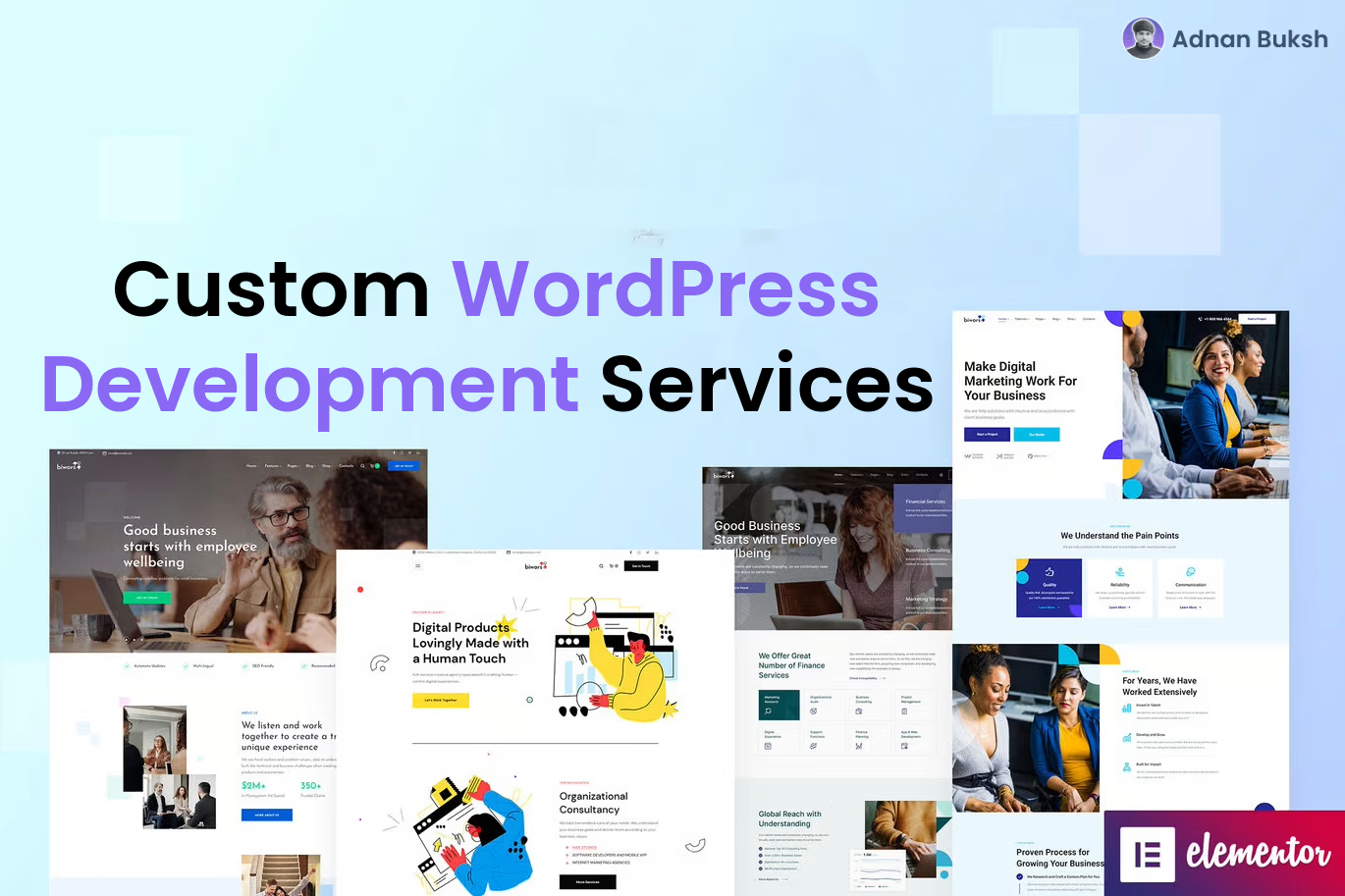
Custom WordPress development means a website built specifically for your business — not a modified theme, not a page builder stretched beyond what it was designed for, and not a template that a hundred other businesses are also using.
I provide custom WordPress development services for businesses across India. Every build starts with a clean, lightweight theme coded from scratch, structured around your content, your customers, and the searches they make. No unused scripts loading in the background. No plugin stack compensating for a theme that cannot do what you need. Just clean PHP, structured HTML, and CSS written for your specific project.
Custom WordPress website development projects are quoted as fixed flat rates after scope review, with entry-level custom builds starting in the ₹25,000 range. Everything is confirmed in writing before work begins. You can read more about how I work or send your requirements directly.
Bespoke WordPress development exists because themes and page builders have hard limits. A multipurpose theme is designed to work for thousands of different websites, which means it includes thousands of features you will never use. All of that code loads on every page whether you need it or not. Page builders generate deeply nested HTML, inline styles, and scripts for widgets you are not using. The result is a site that works, but is heavier, slower, and harder to maintain than it needs to be.
Custom WordPress design inverts the model. Your site includes only the code it actually needs. Every template file serves a specific purpose. Every script is loaded where it is required and nowhere else. The admin experience is designed around your content types, not around a generic set of theme options. The result is a site that loads faster, is easier to maintain, and gives you complete freedom over layout and functionality without fighting a theme’s constraints. Speed gains from this approach are covered in more technical detail under the WordPress speed optimization service.
Every custom WordPress developer project here follows the same structure — clean architecture, lightweight code, and a foundation that supports growth rather than constraining it.
What is included as standard:
Effective custom WordPress website design starts with your content structure. What pages does the business actually need? What information does each page carry? How do customers navigate from landing on the site to making an enquiry? These questions determine the architecture before any visual design begins. A service business with five core services and three locations has a different structure than a manufacturer with 40 product categories or a consultant with an article-driven content strategy. When the architecture matches the content, the site feels natural to navigate and the admin experience is intuitive. When it is forced into a template, the business is permanently adjusting its content to fit the design. Every project here starts with content mapping, then structure, then design — in that order. If your current site feels like it is fighting its own architecture, review the rebuild options within this service or read about ongoing maintenance for incremental improvements.
Drop your phone number and website – I’ll take a quick look and suggest how we can make it work better for your business.
Choosing custom development over a theme or page builder is a commercial decision, not a technical preference. Here is a full breakdown of what custom WordPress development services involve, when they make sense, and how to compare options.
Custom WordPress Development vs Theme Customisation — Side by Side:
| Factor | Custom WordPress Development | Theme Customisation |
|---|---|---|
| Code quality | Purpose-built, no bloat | Inherits all code from the theme, including unused features |
| Performance | Optimised from the ground up, PageSpeed scores in the high 90s on desktop | Limited by theme architecture, often struggles to reach 70 |
| Design freedom | Complete — any layout, any feature, any interaction | Constrained by theme options, workarounds required for non-standard layouts |
| Scalability | Built to grow, adding features is straightforward | Hits functional ceilings, complex additions may require rebuild |
| SEO potential | Maximum — clean code, fast loads, proper structure | Limited by theme bloat and inefficient markup |
| Admin experience | Designed around your content types and workflows | Generic theme options panel |
| Security surface | Smaller — no unused code paths, no abandoned theme components | Larger — every theme feature is a potential attack vector |
| Long-term cost | Higher initial investment, lower ongoing cost | Lower initial cost, higher cost over time in maintenance and limitations |
| Ownership | 100% yours, no licensing restrictions or theme dependencies | Subject to theme licensing, update requirements, and potential abandonment |
When Custom WordPress Development Is the Right Choice:
When Custom Development Is Not the Right Choice:
Custom development is not always the correct answer. If your requirements are straightforward and a well-built theme covers them at a lower cost, that is often the more sensible path:
The honest recommendation always leans toward the option that best fits the actual requirement, not the option that generates a larger invoice.
What Is Quoted Separately After Scope Review:
For straightforward business websites without custom functionality, the affordable web design for small business service covers the essentials at a lower price point. Custom development is the right choice when your requirements genuinely need original code.
The Custom WordPress Development Process:
| Phase | What Happens | What You Receive |
|---|---|---|
| Discovery and strategy | Deep review of business goals, target audience, competitor landscape, content requirements, and technical needs | A clear project roadmap, site architecture document, and feature specification |
| Wireframing and UX planning | Low-fidelity layouts mapping user journeys, content hierarchy, and conversion paths | Wireframes showing exactly how users navigate and where key actions happen |
| Visual design | High-fidelity mockups of key pages with typography, colour systems, imagery, and branding | Pixel-perfect designs showing exactly what the site will look like before any code is written |
| Front-end development | HTML, CSS, and JavaScript coded to match the approved designs, with mobile responsiveness built in from the first line | A fully functional front end that looks and works correctly on every device |
| Back-end development | WordPress integration with custom post types, custom fields, template hierarchy, admin interfaces, and custom functionality | A WordPress site where you can manage all content through an intuitive admin panel |
| Performance optimisation | Code minification, image optimisation, caching configuration, database indexing, Core Web Vitals tuning | A site that loads fast and passes Google’s performance standards |
| SEO foundation | Heading hierarchy, schema markup, XML sitemap, clean URL structure, mobile optimisation, internal linking architecture | A site that search engines can crawl, index, and rank |
| Testing and quality assurance | Cross-browser testing, mobile device testing, form validation, link checking, accessibility review | A site free of bugs, errors, and compatibility issues |
| Launch and handover | DNS configuration, SSL setup, server deployment, post-launch monitoring, documentation, and training | A live, secure, functional website plus the knowledge to manage it confidently |
What Bespoke WordPress Web Design Delivers That Templates Cannot:
When you work with a custom WordPress developer operating as an independent practice, the working relationship differs fundamentally from an agency engagement:
For projects that need ongoing technical work after launch, WordPress maintenance services cover updates, backups, security monitoring, and content edits on a monthly plan. If the site is compromised at any point, WordPress malware removal handles cleanup and hardening.
Questions to Ask Before You Hire a Custom WordPress Developer:
“It takes too long.” A custom build typically takes six to ten weeks. A heavily customised theme project often takes nearly as long, with worse results. The timeline difference is smaller than most people assume.
“It is too expensive.” Custom development has a higher upfront cost but lower long-term cost. Theme-based sites often require expensive workarounds, plugin purchases, and eventual rebuilds that make them more costly over three to five years.
“Page builders are just as good.” Page builders are tools, not architecture. They serve a purpose for certain projects but cannot match the performance, cleanliness, and scalability of custom-coded solutions.
“I won’t be able to update it myself.” A well-built custom site includes an intuitive admin interface. Content, pages, and media are managed without touching code. The admin experience is typically better than bloated theme setups because it is designed specifically for what the site actually contains.
“It is only for big companies.” Custom development benefits businesses of all sizes. For a small business in a competitive Indian market, a faster, better-optimised site can be the difference between being found online and being invisible.
A custom WordPress design built on clean architecture is easier to extend over time. Adding a new service page, a new content type, a new integration, or a new language takes hours rather than weeks because the structure supports it. Theme-based sites require increasingly awkward workarounds with each addition until the theme becomes the bottleneck. If your current site has reached that point, rebuilding on a clean foundation is often more economical over three years than continuing to patch something fundamentally constrained. After launch, ongoing care sits under WordPress maintenance services, and if search visibility needs to grow beyond the technical foundation, the freelance SEO expert service covers that work separately.
Every bespoke WordPress development project is built on a foundation that supports growth. New product lines, additional locations, expanded service areas, multilingual versions for regional audiences, and new integrations are all additions rather than rebuilds. The architecture is designed around your content types and your business model, not around a generic theme that treats all businesses the same way. When the site goes live, it is ready for what comes next — not the final version of a design frozen in time. Previous builds are viewable in the portfolio, and the full range of services is listed on the services page. For businesses that need speed work on existing sites rather than a full custom build, the WordPress speed optimization service addresses that directly.
Can’t find what you are looking for?
This is the foundational question, and understanding the distinction helps make a better investment decision.
Premium theme customisation starts with a pre-built theme — a package of PHP templates, CSS styles, JavaScript functionality, and admin options created by a theme developer to be sold to thousands of different buyers. The theme is designed to be flexible enough to work for many different types of websites, which means it includes a vast array of features, layouts, and options, most of which you will never use. When you customise this theme, you are working within the constraints the theme developer established. You can change colours, swap logos, rearrange pre-built sections using the theme's options panel, and perhaps add some custom CSS. But the underlying architecture — the code structure, the way templates are organised, the scripts that load on each page, the database queries that retrieve your content — remains exactly as the theme developer designed it. You are personalising someone else's product.
Custom WordPress development starts from zero. There is no pre-built theme. A developer writes every template file, every CSS rule, every JavaScript function, and every database query specifically for your project. The code is organised around your content, your design, and your business requirements, not around making a theme flexible enough for thousands of different buyers. This means only the features you need are built, only the scripts you use are loaded, the admin interface is designed around your content types and workflows, and the code is structured logically for your site rather than generically for any possible site.
The practical differences are significant. A custom site loads faster because there is no bloat. It is easier to maintain because the code is purpose-built and well-documented — no hunting through thousands of lines of theme code to find what needs changing. It is more secure because there are fewer components and no reliance on third-party theme developers to patch vulnerabilities. It is more flexible because there is no theme framework limiting what is possible. And it is uniquely yours — no other business has the same design, structure, or user experience.
Bespoke WordPress development is the difference between buying a suit off the rack and having one tailored, except that the rack suit also comes with fifty extra pockets you will never use that slow you down every time you move. For businesses serious about their online presence, custom development delivers better performance, better flexibility, and better long-term value.
Custom WordPress development services pricing depends on scope and complexity. Entry-level custom builds start in the ₹25,000 range for smaller projects with straightforward requirements. Mid-range custom builds — with advanced content structures, custom post types, complex template hierarchies, or integrations — typically range higher. Larger custom builds with extensive custom application development can exceed that range considerably.
The price difference between custom development and theme customisation comes down to one thing: time. Specifically, the time required to plan, design, and build something from scratch versus starting with a pre-built foundation. A theme provides thousands of hours of development work — templates, styles, scripts, admin panels, documentation — for a one-time fee. That is genuinely good value for many projects. Custom development replaces all of that with purpose-built code. Every template file is written from scratch. Every design element is crafted specifically for your brand. Every interactive feature is developed for your specific use case.
Focusing only on upfront cost misses the larger financial picture. Theme-based sites often require expensive workarounds. You pay for premium plugins to add functionality the theme does not support. You pay for a developer to fight with theme limitations when you need something the theme was not designed to do. You pay for performance optimisation that can only go so far because the theme's architecture is inherently heavy. And you likely pay for a complete rebuild sooner, because themes have functional ceilings and growing businesses hit them faster than expected.
When you hire a custom WordPress developer, you are making a higher initial investment for a lower total cost of ownership over the site's lifespan. A well-built custom site can serve your business effectively for four to seven years with proper maintenance, while theme-based sites often need major overhauls or complete rebuilds within two to three years. Viewed over that timeline, custom development is often the more cost-effective choice, especially for Indian businesses where the website directly generates enquiries and revenue.
A fixed-price proposal is provided after understanding your project requirements. You will know exactly what you are investing before work begins — no open-ended hourly billing, no scope creep, no surprises. For straightforward business websites without custom functionality, the affordable web design for small business service offers a lower-cost entry point that may be the better fit.
A custom WordPress website development project typically takes six to ten weeks from initial consultation to launch, depending on scope and complexity.
The discovery and planning phase (weeks one to two) involves detailed conversations about business goals, target audience, content strategy, and technical requirements. A site architecture document, content inventory, and feature specification are produced that serve as the blueprint for everything that follows. This phase is critical — time spent planning prevents expensive changes later.
The design phase (weeks three to five) includes wireframing key page layouts, creating high-fidelity mockups, and refining the visual design based on your feedback. You see exactly what the site will look like before any code is written. This is where most client collaboration happens, and the timeline depends significantly on how quickly you can review designs and provide consolidated feedback.
The development phase (weeks six to nine) is where approved designs become a functioning WordPress site. Work happens on a private staging server where you watch progress through a live preview link. You see pages taking shape, test interactions, and provide feedback throughout. For projects with extensive custom functionality, this phase extends accordingly.
The testing and launch phase (weeks nine to ten) includes cross-browser testing, mobile device testing, performance optimisation, SEO configuration, content population, and final review. Every form, link, and interactive element is tested before going live. After launch, documentation is provided along with a support period for questions and adjustments.
The biggest factor affecting timeline is content readiness. If all page copy, images, and brand assets are prepared before development begins, the project moves efficiently. If content is being created during development, the timeline extends. For Indian businesses with launch deadlines tied to events or campaigns, start the process with buffer time built in and the schedule works backward from that deadline to ensure delivery.
If your site is currently underperforming and needs a rebuild rather than a fresh build, the initial audit phase adds a few days to the timeline but rarely changes the overall estimate significantly. If you need to preserve search rankings during a rebuild, URL mapping and redirect planning are included as part of the process.
A well-executed custom WordPress design gives you complete control over your content without requiring technical knowledge. This is actually one of the primary benefits of building custom — the admin experience is designed around your specific content rather than being a generic interface that assumes nothing about what you are managing.
Here is what that means in practice. If you run a services business, the admin panel has clearly labelled fields for services, categories, pricing, and any other attributes relevant to what you sell — not generic posts with custom fields you have to figure out yourself. If you have multiple locations, there is a dedicated interface for managing locations with fields for address, phone number, opening hours, and map coordinates. If you publish case studies, they have their own content type with exactly the fields they need. Updating content is as simple as filling in forms — no coding, no page builders, no confusion.
Beyond content updates, page templates are built with flexible sections. Need to add a new testimonial to the homepage? Select it from a dropdown. Want to rearrange the order of sections on a service page? Drag and drop. Need to create a landing page for a new campaign? Duplicate an existing template, swap the content, publish. These capabilities are built into the admin interface, and you do not need to touch code or hire a developer for routine updates.
For more substantial changes — adding entirely new functionality, creating new page templates, integrating with new third-party services — a developer is needed. This is true of any website, including theme-based ones. The difference with custom development is that the code is clean, organised, and well-documented, so any competent custom WordPress developer can pick up where the original build left off and make changes efficiently. You are never locked into working with just one person.
After launch, documentation specific to your site is provided, walking through every common task. You also remain supported for any questions during the complimentary post-launch period. The goal is that you feel confident managing the site day to day, with expert help available when you need something beyond routine content updates. If ongoing hands-on management is preferable, WordPress maintenance services include content-edit hours as part of the monthly plan.
Search rankings can be preserved during a rebuild if the process is handled correctly. The risk of losing rankings comes from shortcuts — changing URL structures without redirects, dropping existing content, or launching without proper technical SEO configuration.
URL preservation and redirect mapping is the most important step. Every existing URL is mapped to its new equivalent. If a page slug needs to change, a 1:1 server-level redirect is configured so the search engine equity transfers cleanly. Redirect chains are avoided, redirects are tested before launch, and the redirect map is documented for future reference. This single step prevents the vast majority of ranking loss during rebuilds.
Content preservation and improvement is the second step. Existing content that ranks is preserved, not dropped. Where content is being rewritten, the new version is reviewed for keyword coverage and structural integrity before launch. Pages that are intentionally being removed are redirected to the most relevant remaining page rather than left as 404s.
Technical SEO parity or improvement is the third step. The new site launches with the same or better technical foundation than the old one — proper heading hierarchy, schema markup, XML sitemap, internal linking, mobile optimisation, and page speed. If the old site was weak in any of these areas, the rebuild is an opportunity to strengthen them rather than merely maintain the status quo.
Staging review and pre-launch testing is the fourth step. The staging site is set to noindex during development so it does not compete with the live site in search. Before launch, sitemaps, robots.txt, canonical tags, and structured data are all verified. After launch, Google Search Console is used to submit the new sitemap and monitor for crawl errors.
Beyond those safeguards, the rebuild typically improves rankings rather than harming them because the new site removes technical weaknesses that were holding the old site back. Faster load times, cleaner code, and better structure all support stronger search performance over time. For businesses that need additional SEO recovery work after a rebuild, the freelance SEO expert service covers technical audits and on-page optimisation. For long-term ranking growth through link building, backlink building services handle that separately. If the current site has active security issues, WordPress malware removal should be addressed before the rebuild begins.
A written scope before payment. Every project begins with a fixed flat-rate proposal covering exactly what is included, how many pages, which features, and the total cost. Scope additions are quoted separately and proceed only with your written approval. There are no mid-project surprises.
A staging environment throughout. Development happens on a private staging server with a live preview link provided early. You see real progress rather than waiting weeks for a reveal, and there is always a working build to show for money paid.
Documented communication. Every scope agreement, payment acknowledgment, milestone approval, and credential handover is confirmed over email at [email protected]. Nothing relies on messages that can be lost or disputed.
A payment schedule tied to delivery. For standard projects, fifty percent is paid at kickoff and the balance is paid after you review and approve the completed staging site, before live deployment. For larger custom builds above ₹50,000, the schedule is milestone-based — typically forty percent at kickoff, forty percent at mid-build, and twenty percent at final release.
Assets in your own name. Domain and hosting accounts are always registered under your name, never mine. If we part ways, you keep the domain, hosting, code, and database.
A 14-day complimentary support period after launch, during which any build-related issue is resolved at no cost.
A 30-day technical bug-fix warranty covering any technical defect, layout glitch, or code error directly related to the delivered scope. It does not cover breaks caused by third-party plugin updates after handover or code changes made by someone else.
An optional small paid trial. If you want proof before committing to a full project, we can start with a smaller engagement — a single page build, a specific technical fix, or a speed optimisation. You experience the communication and quality first, then decide whether to continue.
What I cannot do is undo a past experience. What I can do is operate so that every stage is documented, every payment is tied to delivered work, and every asset ends up in your name. If you want an honest assessment of your project before committing, send your requirements through the contact page and you will receive a written response within 24 hours.
Send a short description of your project — what the business does, what the website needs to achieve, and any specific functionality or design requirements. You will receive an honest assessment of whether custom development is the right fit, and a fixed flat-rate quote covering the full scope, with no obligation and no sales pressure.
I’ve been trusted by business owners, startups, and professionals
who needed a reliable WordPress expert—and their feedback means everything to me.
EXCELLENT
Based on 11 reviews
Posted on Google![]()
Sujal YadavTrustindex verifies that the original source of the review is Google.
Took help for SEO and small website changes. Everything was done on time and without hassle.Posted on Google![]()
Vinit RevankarTrustindex verifies that the original source of the review is Google.
I’ve worked with a few developers before but Adnan is the first one who actually kept things simple. He built exactly what I asked for without any unnecessary features or extra costs. If you need someone honest for your web project, he's the one.Posted on Google![]()
Ayaan KhanTrustindex verifies that the original source of the review is Google.
I've konwn Adnan very well He is knowledge is very useful whenever I got stuck on my work he is always solve my problemPosted on Google![]()
NitinTrustindex verifies that the original source of the review is Google.
I've known Adnan for a while and his knowledge of digital foundations is on another level.Posted on Google![]()
Saurav AnandTrustindex verifies that the original source of the review is Google.
I’ve known Adnan for a while and his technical knowledge is top-tier. Whenever I'm stuck on a complex issue, he’s the first person I call. The guy just knows how to build things the right way.Posted on Google![]()
Shreeya BanerjeeTrustindex verifies that the original source of the review is Google.
I’m a developer myself but got stuck on a nasty virus injection. Adnan jumped in and cleared the whole directory by the next morning. Professional, fast, and knows his way around code. 5 stars well deserved.Posted on Google![]()
Ashal MohammadTrustindex verifies that the original source of the review is Google.
Adnan managed to fix a site error that two other people couldn't figure out. He’s efficient, professional, and clearly knows his stuff inside out.Posted on Google![]()
Sk MrTrustindex verifies that the original source of the review is Google.
It's rare to find someone who actually listens and delivers exactly what they say they will. Adnan was a total pro from day one. If you're on the fence, just go for it.Posted on Google![]()
Maajeed SayedTrustindex verifies that the original source of the review is Google.
Adnan were punctual, efficient and professional in their digital services! Highly recommended!Verified by TrustindexTrustindex verified that these reviews were published on WebFreelancer's Google Business Profile. Learn more
No time to wait ? Call me ☕️ 🍞
I’m a freelance website developer passionate about building SEO-friendly, high-performing websites that help businesses grow online.