A client called me last week frustrated with his Google Business Profile. He’s a local electrician. His profile was verified, photos uploaded, categories correct, reviews coming in. But his phone wasn’t ringing the way it used to.
“I’m doing everything right,” he said. “Why am I not showing up?”
I pulled up Google Maps and searched for his service in his area. His profile appeared on page two. The top three spots all belonged to electricians with websites—not just profiles, but actual sites with service pages, project photos, and content updated within the last month.
He had visibility, but not the right kind. And in local search, that distinction matters more than most business owners realize.
Let me explain what’s happening under the hood when someone searches for a local service.
Google’s local algorithm evaluates three main categories: relevance, distance, and prominence. Relevance is whether your business matches what the user searched for. Distance is how far you are from the search location. Prominence is how well-known your business is—online and offline.
Here’s what most business owners miss: prominence isn’t just review count. It’s the entire ecosystem of information Google can find about you. Your Business Profile provides some of that information. Your website provides much more.
When Google decides which electrician to show in the top three map positions, it looks at:
A profile alone answers the first question minimally. A properly built WordPress site answers all of them.
I’ve tested this repeatedly. Businesses with affordable web design for small business that includes local content and technical optimization consistently outrank competitors with profiles only—even when those competitors have more reviews.
Let’s walk through a real search scenario.
A homeowner in Pune notices flickering lights. They open Google and type “electrician near me” or “electrical repair Kothrud.”
Google’s algorithm now has to figure out intent. Are they looking for emergency service? Routine repair? Installation? The algorithm looks at their search history, location, time of day, and device. But it also looks at what content exists to match that query.
If your website has a page titled “Emergency Electrician in Kothrud—24 Hour Service” with content about common electrical emergencies, response times, service areas, and pricing estimates, Google has clear signals that you’re relevant to that search.
If you only have a Business Profile with “Electrician” as your category and some photos of junction boxes, the algorithm has much less to work with. You’re in the pool of possible results, but you’re not strongly matched to the specific intent.
This is why I build sites with custom wordpress development that includes separate pages for each service and each location. Not for human readers primarily—though they benefit—but for search engines to understand exactly who you serve and where.
Here’s where we get into how a website actually communicates with search engines.
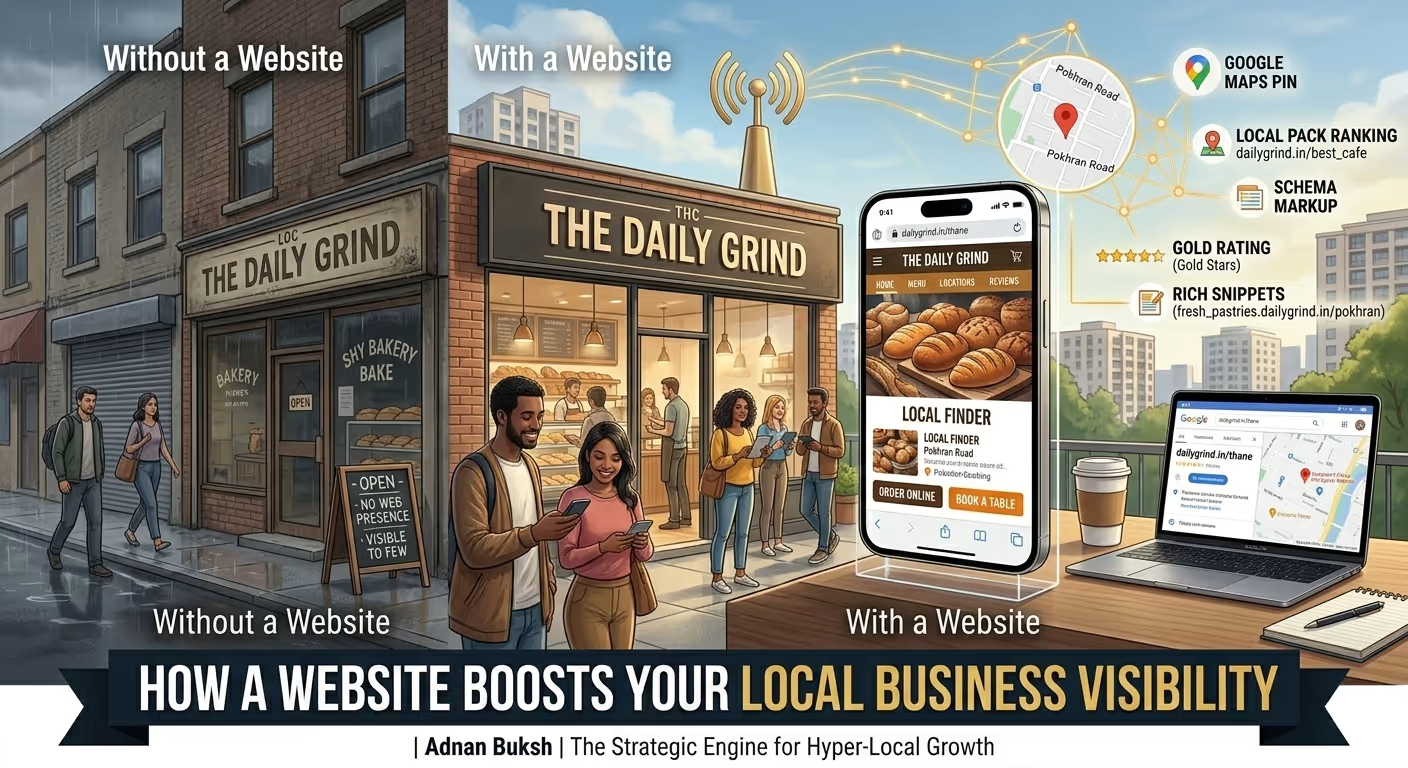
Schema markup is code you add to your site that helps search engines understand your content. For local businesses, LocalBusiness schema tells Google your name, address, phone number, business hours, service area, and more. It’s structured data that confirms and expands what’s on your Business Profile.
When I build a site, I implement this schema manually—not relying on plugins alone, because plugins can conflict or output incorrectly. The schema needs to match exactly what’s on your profile. Inconsistent information confuses Google and hurts visibility.
But schema is just one layer. Site structure matters just as much.
A local business site should have:
This structure isn’t complicated, but it requires intentional design. Off-the-shelf themes often ignore these details. That’s why hiring a wordpress developer who understands local SEO makes a difference—the architecture is built for visibility from the start.
I see business owners make the same content mistake repeatedly: they write for themselves, not for searchers.
A plumbing company might have a homepage that says “Quality Plumbing Services Since 2005—Call Today.” That’s fine for someone who already knows them. But it doesn’t capture the person searching for “fix leaking pipe” at 11 PM.
Effective local content answers the questions people are actually asking. Not keyword-stuffed nonsense, but genuine information about specific problems.
A plumber’s site might include:
Each of these topics targets a specific search query. Each page builds relevance for related terms. Each piece of content positions you as someone who understands the customer’s problem, not just someone who wants their business.
This approach requires ongoing effort. A site built and abandoned won’t maintain visibility. Through wordpress maintenance services, I help clients keep content fresh—updating service pages, adding new information, removing outdated details. Search engines notice when sites stay active.
Here’s a technical detail that matters more than most business owners realize.
Google’s page speed metrics affect rankings—including local rankings. If your site takes six seconds to load on mobile, you’re at a disadvantage against competitors whose sites load in two seconds.
Why does this matter for local search? Because local searches happen predominantly on mobile devices. Someone searching for a nearby restaurant, plumber, or dentist is usually standing somewhere with their phone in hand. They want information immediately.
When a site loads slowly, users bounce back to search results and try another option. Google tracks this behaviour. If searchers consistently click your result and immediately return to try someone else, Google interprets that as your site not meeting the need—and your rankings drop.
I’ve fixed slow sites through wordpress speed optimization service and watched their local visibility improve without any other changes. The technical improvements—image optimization, caching, database cleanup, code minification—tell Google the site provides a better user experience. Rankings follow.
A website doesn’t just help with Google. It feeds every other platform where customers might find you.
When someone hears about your business and searches for you on Facebook, what do they find? If you have a site, they find your business name, link to your site, and can click through to learn more. Without a site, they find your page—which might be fine—but they have nowhere to go for deeper information.
When you’re mentioned in a local directory, blog, or news site, where do they link? To your website. Those backlinks build authority that helps your search rankings. Without a site, those mentions link nowhere, and you lose the ranking benefit.
When you run local ads on any platform, where do they send traffic? To a landing page ideally. Sending ad traffic to a social media profile or Google Business Profile limits what you can do with that visitor. They can’t explore your services, read detailed information, or enter a sales funnel.
A website becomes the central hub that all other channels point to. It’s the destination where interested people become customers.
I want to address something less technical but equally important.
A local business with a professional website communicates stability. It tells potential customers you’re established enough to invest in your online presence. It gives them a place to verify you’re legitimate before they call.
Think about how people evaluate service providers today. They don’t just want a phone number. They want to see your work, understand your approach, read about your background, and feel confident you’re the right choice.
A Business Profile provides basic information. A website provides depth. Before-and-after photos. Detailed service descriptions. Team member profiles. Answers to common questions. Explanations of your process. All of this builds trust before the first conversation.
I’ve had clients tell me potential customers mentioned specific pages on their site during initial calls—”I saw your article about bathroom renovations, and that’s exactly what I’m looking for.” The site didn’t just generate a lead; it pre-qualified the lead and established common ground before they spoke.
That doesn’t happen with a profile alone.
Let me emphasize the mobile piece because it’s critical for local business.
When I build a site through affordable web design for small business projects, I test everything on actual mobile devices—not just browser resize tools. Because local customers interact differently on phones.
They want:
A site that looks great on desktop but frustrates mobile users will lose local customers. They’ll leave and find someone whose site respects how they’re searching.
Google knows this. Mobile-friendliness is a ranking factor. But more importantly, it’s a conversion factor. A local business that makes itself easy to find and contact on mobile gets more calls.
Here’s what I’ve observed working with local businesses over time.
The ones with well-built websites don’t see dramatic spikes in visibility overnight. Instead, they see gradual improvement that compounds. A new service page ranks for a specific term. A blog post about a common problem starts attracting traffic. Local citations build over months. Reviews come in and link to the site. Each element reinforces the others.
After a year, they’re firmly established in local search results. New competitors appear and struggle to catch up because they’re starting from zero while the established site continues building.
This cumulative effect is why starting matters more than waiting for perfect. A site built now, with solid fundamentals and regular attention, will outperform a site built later—even if the later site has better design or more features. Time in market matters in local search.
Back to the electrician who wasn’t showing up.
After we built him a proper site with service pages, location targeting, proper schema, and mobile optimization, his profile started appearing in the top three for his primary services. Not because his profile changed—but because Google now had hundreds of pages of content confirming his relevance and prominence.
His visibility isn’t just about map position anymore. People find his site directly through search. They read his content, look at his photos, and call with specific questions about services they’ve already researched. The calls are better qualified. The jobs are more profitable. The business grows without spending more on advertising.
That’s what visibility actually means. Not just being seen—but being found by the right people, at the right time, with the right information to make a decision.
A website makes that possible. Nothing else does.
Want to understand how a site could improve your local visibility? I work directly with business owners to build WordPress sites designed for local search performance. Let’s talk about your situation and whether a site makes sense for you.


Working with Adnan has been a pleasure. Better yet - I alerted them of a site hacked issue before going to sleep. The issue was fixed the next morning. I couldn't ask for better support. Thank you Adnan! This is easily a 5 star freelancer.

Adnan understood our business needs perfectly and delivered a website that exceeded our expectations. The design is modern, the functionality seamless, and our online presence has never looked better. Highly recommend their services!

As a gym owner, I'm thrilled with Adnan's exceptional web development service. The website he's built is visually stunning and highly functional. I highly recommend Adnan for businesses seeking to elevate their digital presence.

Love the website design by Adnan Buksh. It's modern and just what I wanted. Highly recommend!





Online • Typically replies in minutes