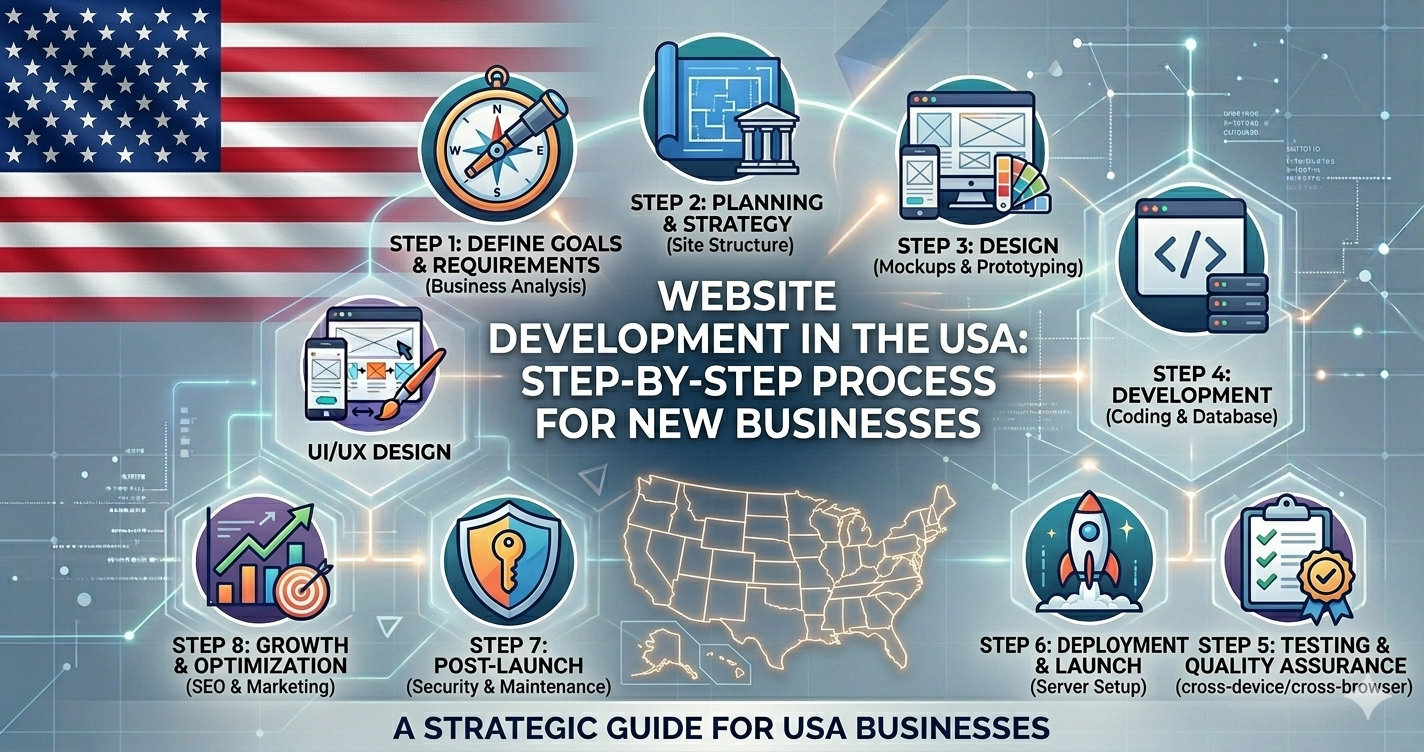
Starting a new business comes with a long list of priorities, and building a website often sits somewhere in the middle—important, but rarely urgent until it becomes critical. Many entrepreneurs assume website development is simply about picking a template and adding content. The reality is more complex, and misunderstanding the process leads to delayed launches, unexpected costs, and sites that fail to perform.
A structured website development process removes uncertainty. It establishes clear milestones, manages costs, and ensures the final product actually supports business goals. For new businesses in the USA, understanding this process before engaging a developer prevents common pitfalls and sets realistic expectations from the start.
This article outlines the complete website development lifecycle—from initial discovery through launch and beyond—with practical insights into how each phase typically unfolds for businesses operating in the US market.
Website development is not a single task but a sequence of interdependent phases. Each phase builds on the previous one, and shortcuts taken early often create problems later. The standard lifecycle includes discovery, planning, design, development, testing, launch, and post-launch maintenance.
What many new business owners overlook is that the most important decisions happen before any code is written. Clarity about goals, audience, and required functionality directly determines how smoothly the remaining phases proceed.
Every successful project begins with a clear understanding of what the website needs to accomplish. This phase involves defining the purpose of the site, identifying the target audience, and documenting specific features and functionality.
For businesses in the USA, this phase typically takes one to two weeks, depending on complexity. During discovery, key decisions include:
The reason this phase matters is straightforward: scope changes become exponentially more expensive once development begins. A well-documented requirements list serves as the foundation for accurate cost estimates and timeline projections.
Once requirements are clear, the technical foundation is established. This includes selecting the appropriate content management system (CMS), defining hosting requirements, and mapping out the site structure.
For most business websites, WordPress serves as a practical choice due to its flexibility, extensive plugin ecosystem, and manageable maintenance requirements. However, the specific implementation matters more than the platform choice. Factors that influence technical decisions include:
During planning, developers also establish the information architecture—how pages relate to each other and how users navigate through the site. Poor information architecture leads to frustrated visitors and lower conversion rates, regardless of how well the site looks.
Design extends far beyond visual appearance. It encompasses user experience (UX), conversion optimization, and brand representation. The design phase typically produces wireframes first—structural layouts showing content placement—followed by visual design mockups.
Common mistakes at this stage include:
Focusing on aesthetics over usability. A visually striking site that confuses visitors will underperform a simpler, clearer alternative. Design decisions should always consider how users actually interact with the site.
Skipping mobile-first considerations. In the US market, mobile traffic accounts for over half of all web visits. Designing for desktop and adapting to mobile creates compromises. A mobile-first approach ensures the critical experience works well on the devices most visitors use.
Neglecting load speed implications. Heavy imagery, custom fonts, and complex animations impact performance. Design choices made without considering technical limitations often require compromises during development or result in a slow site.
The design phase typically concludes with approval of static mockups before any development work begins. This separation ensures stakeholders can review and confirm the visual direction without the complexity of interacting with unfinished functionality.
Development transforms approved designs into a functioning website. This phase includes front-end development (what users see and interact with) and back-end development (functionality, data management, and integrations).
For content-driven sites, content integration often runs parallel to development. Waiting until development finishes to add content creates delays. A more efficient approach involves preparing content during earlier phases so it is ready when development reaches the integration stage.
Key considerations during development:
Performance optimization. Code quality, image optimization, caching implementation, and database efficiency directly affect load times. Google’s Core Web Vitals have become ranking factors, making performance a search visibility concern as much as a user experience one.
Security implementation. Security is not a one-time setup but a combination of practices including secure hosting, regular updates, proper user permission structures, and ongoing monitoring. For businesses handling customer data, these considerations carry legal implications.
SEO structure. Technical SEO—clean URL structures, proper heading hierarchy, XML sitemaps, and schema markup—should be implemented during development, not added after launch. These elements form the foundation for content-focused SEO efforts.
Testing is where theoretical functionality meets actual performance. A comprehensive testing phase includes:
The cost of fixing issues increases dramatically after launch. What takes minutes to adjust during development can require hours of troubleshooting once the site is live and actively used. Testing should be methodical and documented, ensuring all identified issues are resolved before launch.
For e-commerce sites, payment processing and order workflows require particular attention. Testing should include complete transaction simulations to verify the customer experience from cart to confirmation.
Launch is not the finish line but a transition point. A successful launch involves more than making the site publicly accessible. Key launch activities include:
The days following launch require close monitoring. Unexpected issues often surface only under real-world conditions with actual visitor traffic and behavior. Having a clear process for identifying and addressing post-launch issues ensures problems are resolved quickly without disrupting business operations.
Website development costs vary significantly based on complexity, but understanding general ranges helps with budgeting. For new businesses in the USA:
These ranges assume custom development rather than template-based solutions. Template-based approaches can reduce initial costs but often create limitations for scalability and unique functionality requirements.
Timelines depend heavily on client responsiveness, particularly during content gathering and review phases. Projects frequently extend not because of development complexity but because of delays in feedback cycles or content delivery.
Prioritizing cost over value. Selecting a developer based solely on price often results in higher long-term costs through rework, poor performance, and delayed launches. A competent developer who asks clarifying questions and pushes back on unrealistic assumptions typically delivers better outcomes than one who simply quotes low and figures things out later.
Underestimating content requirements. Writing website content takes significantly longer than most business owners anticipate. Starting content development early in the process—ideally during discovery—prevents launch delays.
Neglecting ongoing maintenance. Websites require regular updates, security monitoring, and occasional troubleshooting. Factoring maintenance into the operating budget from the start prevents urgent issues from becoming expensive emergencies.
Chasing features without purpose. Adding functionality because it seems impressive rather than because it serves a business goal creates unnecessary complexity, higher costs, and maintenance burden. Every feature should tie to a specific business outcome.
How long does website development typically take for a new business?
A standard business website with 5–10 pages generally takes 6–10 weeks from initial discovery to launch. E-commerce sites or projects requiring custom functionality typically take 12–16 weeks. Timeline estimates should account for content preparation, design reviews, and testing—phases where delays commonly occur.
What should be prepared before contacting a developer?
Having clear business goals, a list of required features, brand assets (logo, colors, existing content), and examples of websites with design or functionality you prefer helps developers provide accurate estimates. Understanding the target audience and primary conversion goals is equally important.
What is the typical cost for website development in the USA?
Costs vary by complexity and location. A standard business website ranges from $3,000–$8,000. Custom sites with integrations or e-commerce functionality typically range from $8,000–$25,000. Hosting, domain registration, and ongoing maintenance are separate recurring costs.
What should be included in a development contract?
Contracts should clearly define project scope, deliverables, timeline, payment schedule, intellectual property ownership, and post-launch support terms. Specifics about number of design revisions, content pages included, and which tasks are client responsibilities prevent scope disagreements later.
Does a new business need custom development or can a template work?
Templates work well for businesses with standard needs and limited budgets. Custom development becomes valuable when specific functionality, unique design requirements, or scalability needs exceed what templates offer. The decision depends on business goals, not just initial cost.
How does ongoing maintenance work after launch?
Maintenance typically includes software updates, security monitoring, backups, and occasional content updates. Many developers offer monthly maintenance retainers. Budgeting $50–$150 monthly for basic maintenance is common for standard business websites.
What SEO work should happen during development?
Maintenance typically includes software updates, security monitoring, backups, and occasional content updates. Many developers offer monthly maintenance retainers. Budgeting $50–$150 monthly for basic maintenance is common for standard business websites.
Technical SEO—clean URL structure, proper heading hierarchy, XML sitemaps, schema markup, and page speed optimization—should be implemented during development. Content optimization and link building occur after launch.
Having worked with numerous new businesses across the US, the most successful projects share a common pattern: clear communication about what matters most. Business owners who can articulate their primary conversion goal—whether that’s form submissions, phone calls, or e-commerce sales—consistently end up with more effective websites than those who focus on subjective design preferences early in the process.
Another pattern worth noting: projects where clients underestimate content needs almost always face launch delays. Writing 10–15 pages of clear, benefit-focused content takes more time than most anticipate. Starting content work early—ideally while development progresses—keeps timelines intact.
The pricing expectations in the US market vary considerably by region and project complexity. What remains consistent is that developers who spend time understanding business goals during discovery deliver better outcomes than those who provide quick quotes without asking detailed questions. A developer who pushes back on assumptions, explains trade-offs, and sets realistic expectations is generally worth the investment.