expects a single price for everything needed to get online. The proposal arrives, and suddenly there are line items: discovery, design, development, content migration, testing. The confusion is understandable—what exactly falls under web development services, and what gets billed separately?
The term “web development services” means different things depending on who is providing them. Some developers handle everything from strategy through launch. Others focus strictly on coding and expect the client to manage design, content, and hosting independently. For businesses in the UK, understanding these distinctions upfront prevents budget surprises and scope disagreements later.
This article breaks down what web development services typically include, where the boundaries usually fall, and how to evaluate what a given proposal actually covers.
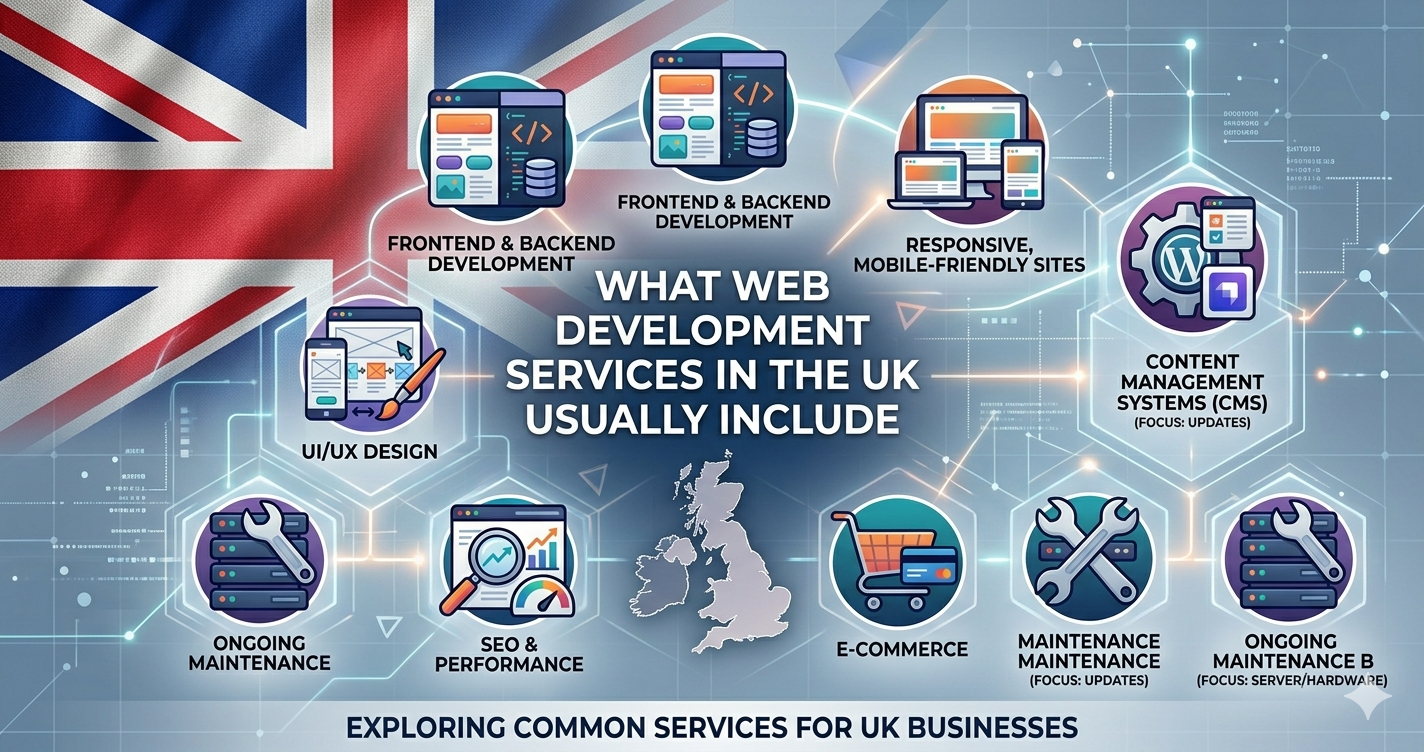
Web development services encompass the technical work required to build a functioning website. However, the scope varies significantly between providers. Understanding the standard components helps in comparing proposals and identifying what might be missing.
Before any code is written, a clear definition of what the site needs to accomplish is established. This phase includes:
In the UK market, discovery typically runs one to two weeks for standard business sites. The reason this phase matters: skipping it leads to scope creep, misaligned expectations, and projects that run over budget. A developer who invests time in discovery is usually more accurate with estimates than one who provides a quote after a brief conversation.
This is the technical core of web development services. Front-end development involves translating designs into HTML, CSS, and JavaScript that function across browsers and devices. Back-end development handles server-side logic, database interactions, and content management system configuration.
What distinguishes competent development from basic implementation:
For UK businesses, mobile performance expectations are high. Sites that load slowly or display poorly on mobile devices lose credibility quickly, regardless of how well they perform on desktop.
Most business websites require a CMS that allows non-technical staff to update content. WordPress accounts for a significant portion of the UK business market due to its balance of flexibility and manageable learning curve.
CMS integration includes:
A common point of confusion: CMS integration is not the same as content entry. Development services typically include configuring the system to accept content, but populating pages with actual copy and images is often a separate responsibility.
Understanding what falls outside standard development services prevents unrealistic expectations.
Design. Many developers partner with designers or work from client-provided designs. Full-service web development services may include design, but it is frequently a separate phase with its own cost structure.
Content creation. Writing copy, sourcing photography, and creating graphics generally fall outside development scope. Some developers offer content services as an add-on, but assuming development includes writing leads to delays.
Hosting setup and domain registration. While developers often assist with hosting configuration, the actual hosting account and domain registration are typically managed directly by the client. In the UK, this separation is common because hosting costs vary significantly based on provider and service level.
Ongoing maintenance. Post-launch support—security updates, plugin maintenance, content adjustments—is almost always a separate service, either billed hourly or through a retainer.
Web development services are priced in three common ways, each with different implications.
Fixed-price project. A single price for a clearly defined scope. This works well when requirements are fully documented upfront. The risk: scope changes become difficult to manage, and developers may resist additions that fall outside the original agreement.
Hourly or daily rate. Time-based billing for work as it occurs. This provides flexibility but requires trust that the developer is working efficiently. Typical developer rates in the UK range from £40–£80 per hour for independent professionals, with higher rates for specialized expertise.
Phased or milestone-based. A hybrid approach where the project is divided into phases (discovery, design, development, launch) each with its own budget. This allows for adjustments between phases based on new information or evolving priorities.
For new UK businesses, phased structures often work well because they allow for course correction without renegotiating an entire contract.
“Development includes unlimited revisions.” Revisions are typically capped in project agreements. Development involves implementing approved designs, not iterating endlessly on visual details. Clarifying revision limits before signing prevents friction.
“A developer handles SEO automatically.” Technical SEO—clean code, proper structure, page speed—is part of competent development. Content strategy, keyword research, and link building are separate disciplines. Expecting a developer to deliver organic traffic results without a dedicated SEO strategy misunderstands where development ends and marketing begins.
“Once launched, the site is finished.” Websites require ongoing attention. Software updates, security monitoring, and occasional content adjustments are normal operational costs. In the UK, businesses increasingly budget £50–£150 monthly for basic maintenance to avoid urgent issues becoming expensive emergencies.
When evaluating web development services, specific proposal elements indicate thoroughness:
A proposal that lacks these details often leads to disagreements mid-project. Developers who provide vague scope descriptions may be protecting themselves from scope creep, but they also leave clients uncertain about what they are paying for.
FAQ
What is typically included in a standard web development package?
A standard package usually includes discovery, design implementation, front-end and back-end development, CMS setup, testing, and launch coordination. Content creation, copywriting, and ongoing maintenance are typically separate. The exact scope varies by provider, so reviewing the proposal against your specific needs is essential.
How much do web development services cost in the UK?
For a standard business website (5–10 pages), costs typically range from £2,500–£6,000. E-commerce sites or projects with custom functionality range from £6,000–£20,000. These ranges assume custom development rather than template-based solutions. Hosting, domain registration, and maintenance are additional recurring costs.
How long does web development usually take?
A standard business website typically takes 6–10 weeks from discovery through launch. E-commerce or complex custom projects often require 10–16 weeks. Timelines depend heavily on client responsiveness during content gathering and review phases, which frequently cause more delays than development work itself.
Do web development services include SEO?
Technical SEO implementation—clean code, proper heading structure, page speed optimization—should be included in competent development. Content strategy, keyword research, and ongoing SEO work are separate services. Some developers offer SEO as an add-on, but standard development does not cover marketing activities.
What should be prepared before engaging a developer?
Having a clear business goal for the website, a list of required features, brand assets (logo, colours, existing materials), and examples of sites with design or functionality you prefer helps developers provide accurate estimates. Knowing the target audience and primary conversion goals is equally important.
Does web development include hosting and domain setup?
Development services typically include configuring hosting and assisting with setup, but the hosting account and domain registration are usually managed directly by the client. This separation allows businesses to maintain control over recurring costs and hosting provider choices.
What happens after the website launches?
Post-launch, a responsible developer ensures the site is functioning correctly, verifies analytics are tracking, and provides documentation for content updates. Ongoing maintenance—software updates, security monitoring, backups, and occasional content changes—is typically handled through a separate maintenance agreement or hourly support.
Working with UK businesses over time has shown a clear pattern: the projects that go smoothly are the ones where both sides understand the boundaries between development and everything else. Clients who assume development includes unlimited design revisions, content writing, or ongoing free support inevitably face friction. The ones who review proposals carefully, ask what is excluded, and plan for separate content and maintenance budgets tend to get better outcomes.
Another observation: UK clients often expect high mobile performance but underestimate what that requires. A site that looks fine on desktop can be unusable on mobile if development doesn’t prioritize responsive behaviour and load speed from the start. Asking about mobile testing practices early in conversations tends to reveal whether a developer treats mobile as an afterthought or as the primary experience.
The pricing expectations in the UK market vary, but one thing holds consistently: developers who push back on unrealistic timelines and explain why certain approaches cost more deliver better results than those who simply say yes to everything. A developer who says “that timeline won’t work because testing needs three days” is demonstrating accountability, not limitations.





Online • Typically replies in minutes