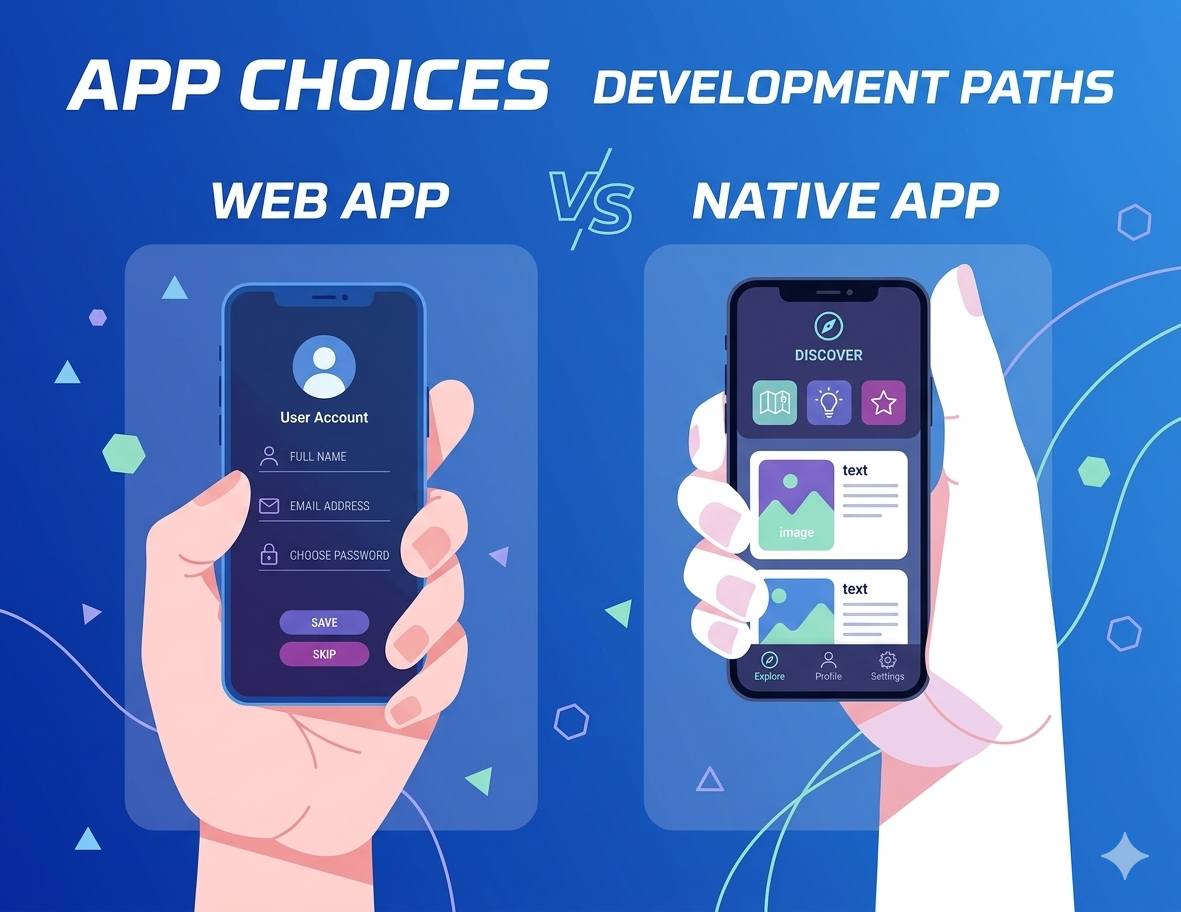
A common challenge in web app development is choosing the right approach before the project even begins. Many businesses assume the decision is purely technical—native apps for performance, web apps for simplicity. In reality, the choice between native applications and Progressive Web Apps (PWAs) affects cost, user experience, scalability, and long-term maintenance.
This confusion often appears when planning digital products for diverse user bases. In markets like India, where device types, network speeds, and user behavior vary significantly, the decision becomes more critical. A solution that works well in one region may not perform the same way under different conditions.
The problem is not a lack of options, but a lack of clarity on how each approach behaves in real-world scenarios. Features, performance expectations, and user accessibility all influence the outcome.
This article breaks down how native apps and Progressive Web Apps differ, how each approach fits into modern web app development, and what factors should guide the decision.
Native apps are built specifically for a platform such as iOS or Android.
They are:
This allows deeper access to hardware features like camera, GPS, and system-level processes.
PWAs are web-based applications that behave like native apps.
They:
The reason PWAs are gaining attention is that they combine accessibility with app-like functionality.
The distinction becomes important because each approach solves a different problem.
In most cases:
Native apps generally perform better because they are built specifically for a platform.
However, modern web app development using PWAs has improved significantly.
This usually depends on:
For simpler applications, the performance gap is often minimal.
Native apps require users to:
PWAs, on the other hand:
In markets like India, where users may avoid large downloads due to data limits, this becomes a major advantage.
Native development often requires:
PWAs use a single codebase, which simplifies updates and maintenance.
The reason this matters is long-term cost. Maintaining multiple versions increases both time and complexity.
Native apps typically involve higher costs because:
For businesses targeting users in India, this can significantly increase the initial investment.
PWAs are generally more cost-efficient.
They:
This usually makes PWAs a practical choice for startups and early-stage products.
The reason behind cost variation is not just development time.
It includes:
Native applications typically take longer to develop.
This includes:
In most cases, this leads to longer launch timelines.
PWAs can be developed and launched faster.
They:
This makes them suitable for faster market entry.
Native apps often provide better engagement due to:
However, this advantage depends on whether users are willing to install the app.
PWAs improve accessibility.
Users can:
In regions with varied device capabilities, this can directly impact user adoption.
In most cases, the decision depends on balancing performance needs with accessibility.
Many decisions are influenced by what is popular rather than what is practical.
This usually leads to:
User behavior plays a major role.
In markets like India:
Ignoring these factors often leads to poor adoption.
Both native apps and PWAs require ongoing updates.
The difference lies in:
Focus on:
This helps determine the right approach.
Consider:
In most cases, the right solution is not about choosing one over the other, but understanding trade-offs.
What is the difference between native apps and PWAs?
Native apps are built for specific platforms like iOS or Android, while PWAs are web-based applications that work across devices. Native apps offer better performance, while PWAs provide easier access and faster deployment.
Which is better for web app development in India?
It depends on the use case. PWAs are often preferred for accessibility and lower cost, while native apps are suitable for performance-heavy applications. User behavior and device diversity in India play a key role in this decision.
Can PWAs replace native apps?
PWAs can replace native apps in many cases, especially for content-driven or service-based applications. However, they may not fully match native performance for complex or hardware-intensive features.
How long does web app development take?
Timelines vary based on complexity. PWAs can be developed faster, while native apps take longer due to platform-specific requirements and approval processes.
Do PWAs work offline?
Yes, PWAs can work offline using caching mechanisms. This makes them useful in areas with inconsistent internet connectivity.





Online • Typically replies in minutes