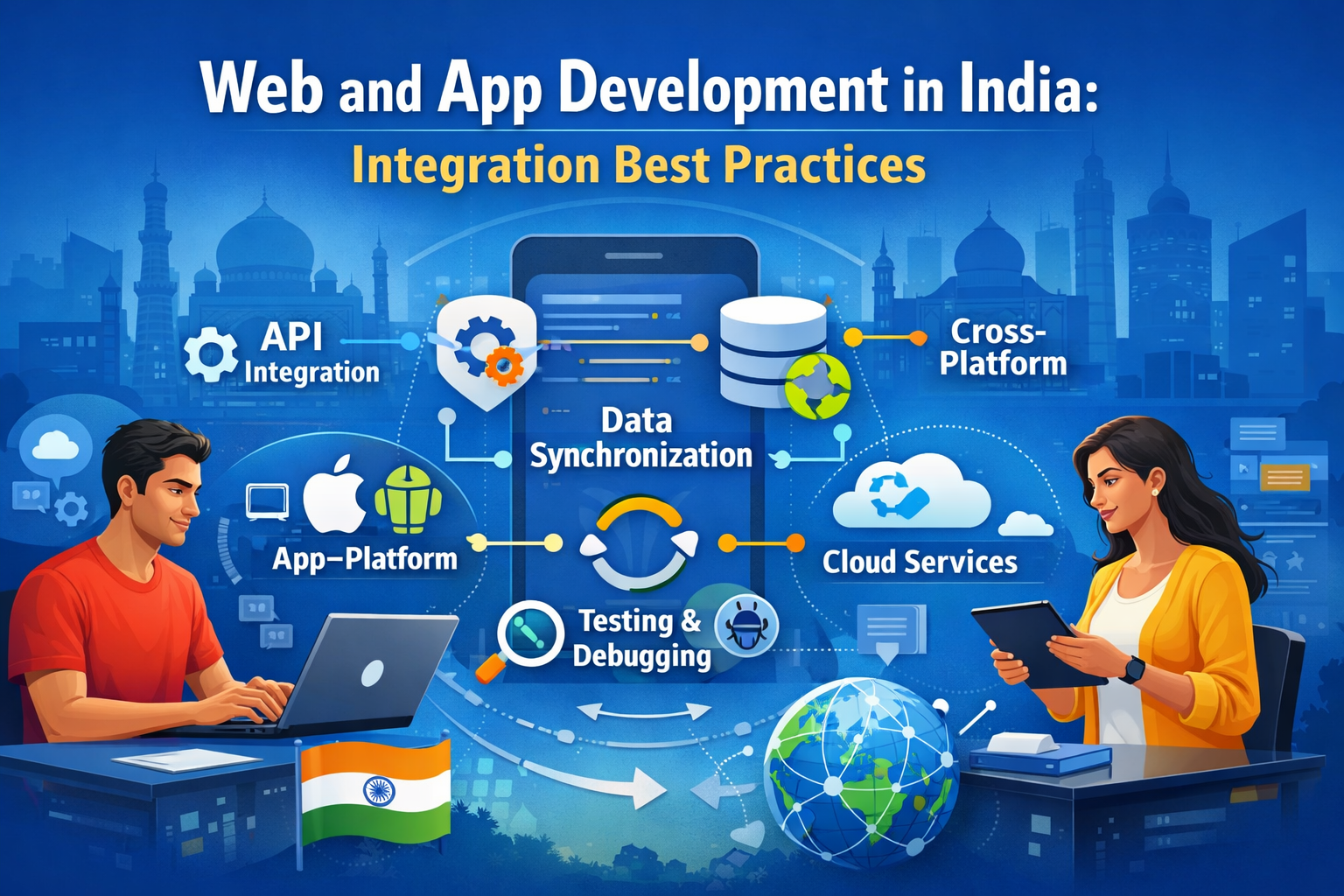
India is a mobile-first nation. With over 750 million smartphone users and rapidly growing internet penetration, businesses can no longer afford to treat their website and mobile app as separate islands. Customers expect to start a task on your website—say, browsing products—and finish it on your app without friction.
That’s where web and app development integration becomes critical. When done right, a unified digital ecosystem boosts retention, simplifies management, and reduces technical debt. But integration is not just about linking a button. It requires architectural discipline. Below are the best practices for successful web and app development integration tailored to the Indian market.
The backbone of any integrated web and app development strategy is a shared backend exposed through well-documented APIs. Whether you use REST or GraphQL, your API should serve both your React website and your Flutter/Kotlin/Swift app.
For example, an Indian eCommerce business can use a WooCommerce backend that powers both the website and a React Native app. A WooCommerce website developer can build the initial store, then extend the same REST API to the mobile team.
Google’s API design guide emphasizes versioning and error handling—both essential when your website and app release on different cycles.
Content should never be duplicated. A headless CMS (like WordPress as a headless backend, Strapi, or Contentful) lets you write content once and deliver it everywhere via API. This is a game-changer for web and app development integration.
If you prefer WordPress, a custom WordPress development approach can turn your familiar admin panel into a headless CMS. For advanced needs, a custom WordPress plugin developer can create custom endpoints tailored to your app’s data requirements.
Nothing frustrates Indian users more than logging in twice. A seamless web and app development integration requires single sign-on (SSO) or token-based authentication (JWT/OAuth). When a user signs up on your website, the same credentials must work in the app—and vice versa.
According to web.dev, secure authentication patterns also improve user trust and reduce cart abandonment.
Indian consumers are price-sensitive and impatient. If a product goes out of stock on your website but still appears available on your app, you lose credibility. Real-time sync is a hallmark of professional web and app development.
Even after launch, performance degrades over time. Regular WordPress speed optimization service ensures your API responses stay fast, which directly impacts how quickly your website and app can sync.
India’s connectivity varies wildly—from 5G in Mumbai to spotty 2G in rural areas. Your integrated web and app development solution must be resilient.
A shared backend architecture actually helps here: both platforms can reuse the same caching and lazy-loading strategies.
Separate analytics for website and app creates blind spots. A single user might browse on a desktop website, then purchase on the app. Without unified tracking, you’ll see two partial journeys.
If you need help configuring tracking without breaking performance, a freelance SEO expert can set up proper event tagging and debug cross-domain/ cross-app attribution.
Integration multiplies attack surfaces. A vulnerability in your website’s API can expose your app’s data. Security must be baked into web and app development integration:
For WordPress-based backends, ongoing WordPress malware removal service and WordPress maintenance services ensure that security patches don’t break your API contracts.
Not every Indian business has the budget for native iOS and Android apps plus a website. A Progressive Web App (PWA) is a legitimate integrated strategy: one codebase that works as a website and can be installed as an app-like experience.
PWAs demonstrate true convergence in web and app development. They offer offline support, push notifications, and home screen installation—all from your existing website. For small businesses, starting with affordable web design for small business that includes PWA capabilities is a cost-effective first step toward full integration.
Simulated lab tests miss real-world Indian network and device diversity. Your web and app development integration should be tested on:
Tools like BrowserStack with real devices in India help, but nothing beats beta testing with actual users across Bangalore, Lucknow, and Guwahati.
When your website and app teams work on the same API, changes break things. Document every endpoint, request/response schema, and deprecation schedule. Use semantic versioning (v1, v2) so that your website can stay on v1 while your app migrates to v2.
This is often overlooked in web and app development projects, leading to late-night emergency fixes. A little documentation upfront saves weeks of debugging.
Before committing to any integrated web and app development project, verify:
Integration is not an afterthought—it’s a core architectural decision. For Indian businesses, unified web and app development delivers better customer experience, lower operational costs, and faster time-to-market for new features. Start with a shared API and headless CMS, then layer on real-time sync, robust security, and India-specific network optimizations.
Whether you’re launching a new venture or modernizing an existing one, consider working with professionals who understand both web and app ecosystems. A solid foundation from a custom WordPress development project can later power a high-performance mobile app. That’s the smart path to digital growth in India.





Online • Typically replies in minutes

