A family-owned bakery in Munich needed a new website. The owner searched for “website design company near me” and found a local agency with a beautiful office. They signed a contract for €8,000. Six weeks later, the agency delivered a site that looked fine on desktop but broke on mobile, had no Impressum, and used Google Fonts without complying with DSGVO. The bakery received a formal warning letter within a month.
The problem was not proximity—it was a failure to verify what the company actually delivered beyond the initial sales conversation. In Germany, where strict data protection laws, mandatory legal disclosures, and regional business cultures create unique requirements, choosing a website design company based solely on location is a mistake.
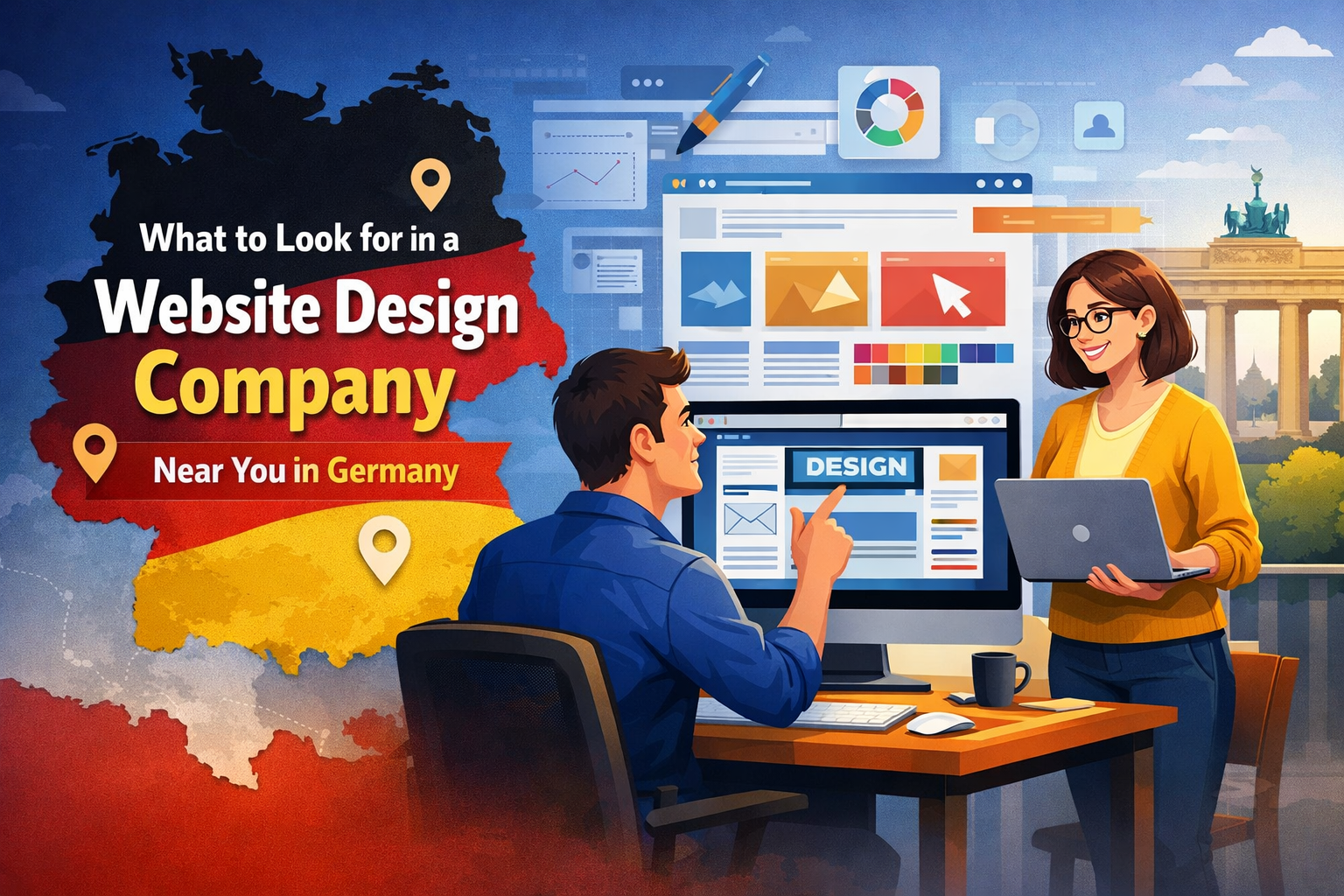
This article explains what to look for when evaluating a website design company near you in Germany. It moves beyond the “near me” filter and focuses on technical competence, legal compliance, portfolio fit, and the practical realities of working with local designers.
Physical proximity offers real advantages in Germany. Same time zone, face‑to‑face meetings, and familiarity with local business practices matter. But the German market also has specific characteristics that make the “near me” search more complex.
Federal and regional differences. Business norms vary between Bavaria, Berlin, and North Rhine‑Westphalia. A design company in Hamburg may not understand the conservative, relationship‑driven expectations of a Mittelstand company in Baden‑Württemberg. Proximity to your customer base matters more than proximity to your office.
DSGVO enforcement. Germany has some of the strictest GDPR (DSGVO) enforcement in Europe. Local companies face real liability. A website design company that does not build DSGVO‑compliant sites creates legal exposure regardless of how close they are.
Mittelstand expectations. Many German businesses expect detailed documentation, clear contracts, and structured project management. A design company that operates on informal agreements and verbal promises will struggle to satisfy these expectations.
The “near me” search should prioritise companies that understand these German‑specific factors, not just those within a 10‑kilometre radius.
Any website design company in Germany must demonstrate competence in three legal areas. Failure to address these is an automatic disqualification.
Impressum and legal pages. German law requires every commercial website to have an Impressum with the owner’s name, address, contact details, and commercial register information (if applicable). The design company must know how to structure these pages correctly. Ask: “Will your design include a properly formatted Impressum template, and who is responsible for populating the correct legal information?”
DSGVO compliance. The design must accommodate:
A design company that dismisses DSGVO as “the client’s responsibility” is shifting legal risk onto you. The design itself must enable compliance.
Barrierefreiheit (accessibility). Germany is moving toward stricter web accessibility requirements, particularly for public sector and certain businesses. Even if not legally required yet, accessible design (WCAG 2.1) is increasingly expected. Ask about their approach to contrast ratios, keyboard navigation, and screen reader compatibility.
A portfolio of beautiful screenshots tells you nothing about technical quality. Dig deeper.
Check live sites, not mockups. Request working URLs for at least three recent projects. Visit each site on a mobile device. Test load speed using Google PageSpeed Insights. A score below 70 on mobile indicates poor optimisation—regardless of how good the design looks.
Inspect mobile behaviour. Many German designers still design for desktop first. Resize your browser window to 375px width. Does the navigation become usable? Are buttons large enough for fingers? Does text overflow containers? Mobile performance is a direct indicator of technical competence.
Ask about their stack. What tools do they use for design (Figma, Sketch, Adobe XD)? Do they hand off to a developer, or do they develop as well? A pure design company that cannot explain how their designs translate to code may produce assets that a developer cannot implement efficiently.
Industry relevance. A company that specialises in e‑commerce may struggle with a complex member portal. A portfolio full of restaurant sites may not translate to B2B industrial equipment. Relevance to your specific business type reduces surprises.
German business culture values clarity and documentation. A website design company near you should reflect that.
Fixed‑price vs. hourly. Most German businesses prefer fixed‑price quotes for design services. Expect a detailed breakdown: discovery, wireframes, design concepts, revisions, asset delivery. Hourly rates for independent designers range from €70–€120; agencies charge €120–€200. Confirm whether Mehrwertsteuer (VAT at 19%) is included or added.
What is excluded. A transparent contract lists exclusions explicitly: development, copywriting, photography, SEO content, hosting setup. If the contract is silent on exclusions, assume nothing beyond design files.
Revision limits. German contracts typically include two to three revision rounds. Additional rounds are billed hourly. Clarify what constitutes a “revision” (e.g., changing colours vs. moving page sections) to avoid disputes.
Ownership of work. The client must own the final design files and assets. Some companies retain rights to reuse design concepts for other clients. This should be stated clearly. If not, assume you own the work.
Payment schedule. Standard is 30–50% deposit, remaining upon delivery of final files. Full payment upfront is unusual in Germany and a red flag.
Proximity is useless if communication is poor. Evaluate how a company communicates during the sales process—it predicts how they will communicate during the project.
Response time. Send an initial inquiry. How long do they take to reply? In Germany, within one business day is standard. Longer delays indicate disorganisation.
Language. Do they communicate fluently in German (if that is your preference) and provide contracts in German? For legal documents, German language versions are essential for enforceability.
Meeting availability. Can they meet in person at a convenient location? While remote work is common, the option for face‑to‑face meetings is a key benefit of local companies. If they refuse in‑person meetings, the “near me” advantage disappears.
Project management tools. Do they use structured tools (Trello, Asana, ClickUp) or shared documents? A clear process with milestones and deadlines indicates professionalism. Vague promises without tracking are a warning sign.
Design work does not end at handoff. A local company should offer ongoing support.
Warranty period. Standard is 14–30 days after final delivery to fix any design defects (e.g., broken layouts, missing assets). Ask for this in writing.
Maintenance retainers. Do they offer monthly or quarterly retainers for design adjustments? Typical costs: €50–€150 per month for minor changes. If they do not offer maintenance, ask for a referral to someone who does.
Handover documentation. What do you receive at project completion? A proper handover includes: source design files (Figma/Sketch), exported assets (logos, icons, images), a style guide (colours, fonts, spacing), and a brief explanation of how to request future changes. Without these, you are locked into the company for even trivial updates.
Emergency contact. What happens if a design issue breaks your site after launch? Is there an emergency contact, and what is the response time? A local company can respond faster than one in a different time zone.
When evaluating a website design company near you, watch for these warning signs:
No Impressum on their own website. A design company that does not comply with German law on their own site will not build a compliant site for you.
Use of remote CDNs for fonts or scripts without consent. If their own site loads Google Fonts from fonts.googleapis.com without a proper cookie banner, they do not understand DSGVO.
Pressure to sign a vague “Werkvertrag” (service contract) without scope details. German law requires clear specifications. A contract that says “design of a corporate website” without page counts, revision limits, or deliverables is insufficient.
Refusal to provide references from German clients. International references are fine, but local references matter more for understanding how they handle German legal and business requirements.
No registered business (Gewerbeanmeldung). A legitimate freelance designer in Germany has a Gewerbeschein or Freiberufler registration. Ask for their Steuernummer (tax number) or Umsatzsteuer-ID (VAT ID). A sole trader without registration may be operating illegally.
Before signing with any website design company near you, verify these items:
What does “website design company near me” mean for a German business?
It typically refers to a company physically located within reasonable travel distance (e.g., same city or region). Proximity offers advantages like in‑person meetings, same time zone, and familiarity with local business culture. However, the term is often used in search results to indicate local presence. Always verify actual location and registration—some companies claim local presence but operate remotely from elsewhere.
How much do website design companies in Germany charge?
For a standard 5–10 page business website, independent designers charge €2,500–€6,000. Small agencies charge €5,000–€12,000. Large agencies charge €12,000–€25,000 or more. These prices exclude 19% VAT. E‑commerce, multilingual sites, or custom functionality increase costs. Quotes below €2,000 likely use templates with minimal customisation.
What DSGVO requirements should a design company address?
The design must enable: a compliant cookie consent banner (opt‑in, not pre‑checked), a privacy policy page template, local hosting of fonts and scripts (no remote Google Fonts), contact forms that collect only necessary data, and no hidden tracking. The design company should provide guidance on what content the client must supply for the privacy policy. Failure to address these creates legal liability for the website owner.
Do I need a local company, or can I work with one elsewhere in Germany?
Working with a company anywhere in Germany is fine—time zone and legal framework are consistent. The “near me” filter is most useful for businesses that value occasional in‑person meetings or have strong regional branding. For purely digital collaboration, a company in another city may offer better value. The key is German registration and DSGVO competence, not physical distance.
What is the difference between a “Webdesign Agentur” and a freelance designer?
Agencies have multiple employees, higher overhead, and often offer bundled services (design, development, SEO, hosting). Freelance designers work alone, charge lower rates, and offer more direct communication. Neither is inherently better. For a small business website, a skilled freelancer with German registration may be ideal. For complex projects requiring multiple specialities, an agency may be worth the premium.
How do I verify a company’s German registration?
Ask for their Steuernummer (tax number) and, if applicable, Umsatzsteuer-ID (VAT ID). You can request a simple invoice for a small deposit to see if the invoice includes their correct tax details. For a limited company (GmbH), check the commercial register (Handelsregister) online. For sole traders, a Gewerbeschein or Freiberufler registration is sufficient. Avoid companies that cannot provide any registration number.
What should be in a German design contract?
A proper contract includes: scope of work (page types, deliverables), number of design concepts, revision rounds, timeline with milestones, payment schedule (deposit and final), exclusions (what is not included), intellectual property ownership (client owns final designs), warranty period, and governing law (Germany). Contracts in German are preferable for legal clarity. English contracts may be acceptable but ensure key terms are defined.





Online • Typically replies in minutes