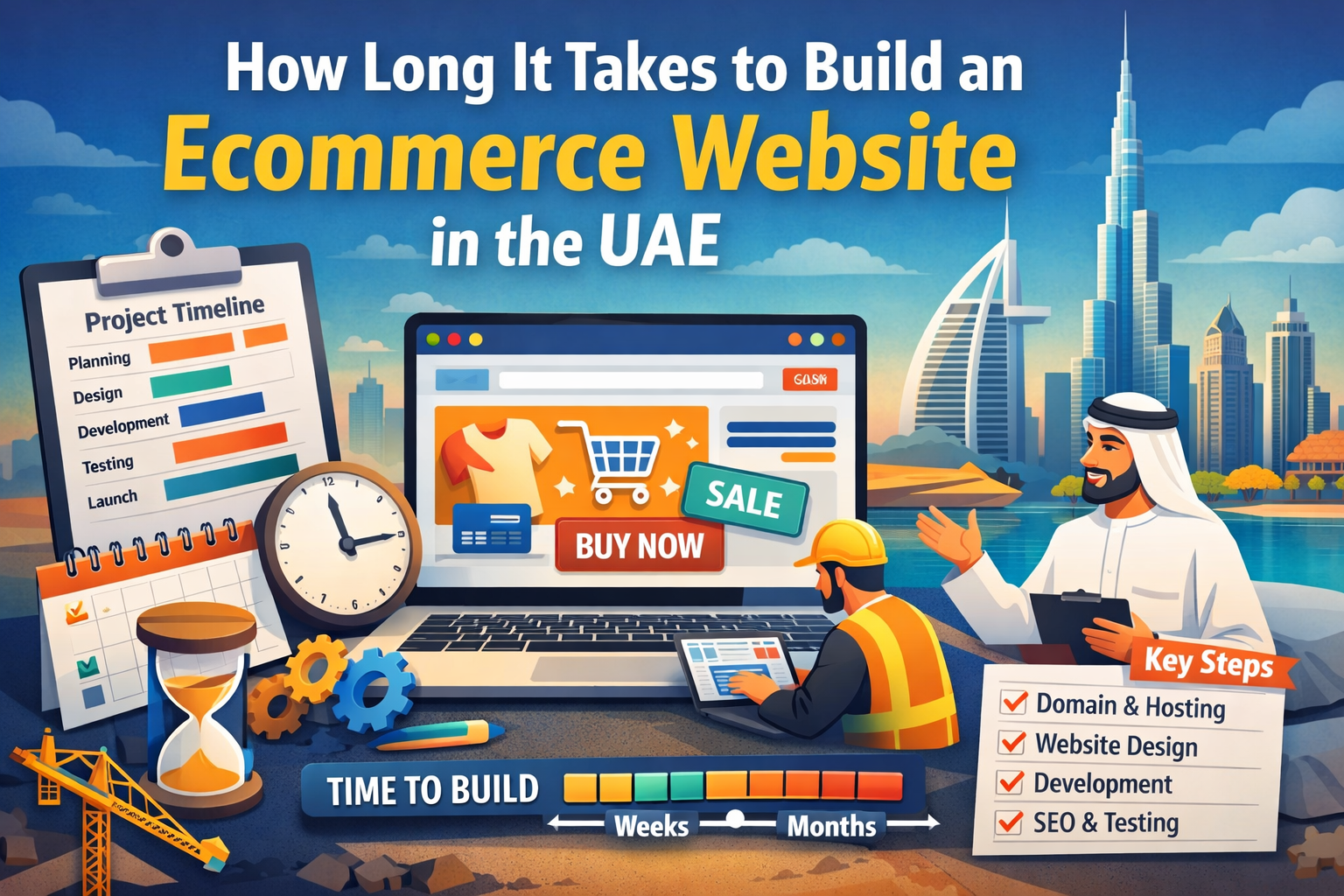
If you’re planning to launch an online store in the UAE, one of the first questions you’ll ask is: how long does it take to build an ecommerce website? The answer isn’t one-size-fits-all. Timelines vary based on complexity, features, integrations, and the expertise of your development partner.
In this guide, we’ll break down the real-world timelines for building an ecommerce website in the UAE – from a basic startup store to a feature‑rich, scalable platform. We’ll also cover local factors like payment gateways, Arabic support, and logistics integrations that can affect your schedule.
The UAE ecommerce market is growing rapidly – Statista projects revenues to exceed AED 27 billion by 2025. Whether you’re a Dubai startup or an Abu Dhabi brand expanding online, every week of delay can mean lost sales. However, rushing to build ecommerce website without proper planning leads to technical debt, poor user experience, and security risks.
Understanding the typical phases and their durations helps you set realistic expectations and choose the right development approach.
Before a single line of code is written, you need a roadmap. This phase includes:
For a straightforward store with <100 products, discovery takes about 1 week. Complex projects with custom workflows or multi‑currency (AED + other currencies) may need 2–3 weeks.
Pro tip: During this phase, many businesses decide to build ecommerce website on a flexible platform like WooCommerce. You can explore specialised help from a WooCommerce website developer to validate your feature list.
Design directly impacts conversion rates. In the UAE, you must consider:
Timeline breakdown:
| Store type | Design duration |
|---|---|
| Pre‑built theme + customisation | 1–2 weeks |
| Custom UI/UX design (unique brand) | 3–5 weeks |
If you need to keep costs low without sacrificing quality, an affordable web design for small business can be a smart starting point – many providers offer ecommerce‑ready templates tailored to the UAE market.
This is where you actually build ecommerce website functionality. The timeline varies enormously depending on the technology stack and features.
Note: If you choose WordPress + WooCommerce, you can leverage a custom WordPress development approach to build exactly what you need without bloated code. This often reduces development time by 20–30% compared to building from scratch.
The UAE has unique payment preferences. Cash on delivery (COD) still accounts for 30–40% of transactions, but buy now, pay later (BNPL) services like Tabby, Tamara, and Spotii are growing fast. Each integration adds time:
Similarly, connecting to local shipping aggregators (Shipa, Zajil, Emirates Post) requires API testing and label generation logic. Plan at least one week for shipping sandbox testing.
Often underestimated – populating your store with product descriptions, images, pricing, and SEO metadata takes time.
| Products quantity | Estimated effort |
|---|---|
| < 50 | 2–3 days |
| 50–500 | 1–2 weeks |
| 500–2000 | 2–4 weeks |
If you’re migrating from an existing platform (e.g., Shopify to WooCommerce, or Magento to custom PHP), add another 1–3 weeks for data cleansing and URL redirection.
Before going live, you must test:
A good rule: one week of testing for every four weeks of development. For an 8‑week development project, allocate 2 weeks for QA.
External reference: Google’s web.dev/measure helps test your ecommerce site’s performance – a slow site can kill conversions. Use it during QA.
Launch day isn’t the finish line. After going live, you’ll need:
Many UAE business owners forget that a build ecommerce website project includes ongoing care. You can reduce risk by scheduling a WordPress speed optimization service immediately after launch – Google Core Web Vitals are now ranking factors, and slow stores lose customers.
If you ever suspect malicious activity (e.g., defacement, unauthorised admin logins), a WordPress malware removal service can clean your site within hours.
Based on the phases above, here’s what you can expect when you build ecommerce website in the UAE:
| Project complexity | Total duration | Best for |
|---|---|---|
| Basic (off‑the‑shelf theme + <200 products) | 4–6 weeks | Startups, test concepts |
| Standard (customised theme, local gateways, bilingual) | 8–12 weeks | Growing SMEs, established brands |
| Advanced (custom design, ERP, multi‑vendor, headless) | 14–20 weeks | Enterprises, high‑volume stores |
These timelines assume a dedicated team (project manager + developer + designer). Delays can occur due to client feedback loops, third‑party API changes, or scope creep.
You don’t always need to wait 3 months. Here are proven ways to launch faster:
WordPress + WooCommerce powers over 30% of all ecommerce websites globally. It’s flexible, well‑documented, and has hundreds of UAE‑compatible plugins. A custom WordPress plugin developer can extend functionality without reinventing the wheel.
Launch with essential features: product catalogue, simple checkout, basic shipping. Add reviews, wishlists, and loyalty programmes post‑launch. This cuts initial development time by 30–40%.
A developer who understands the UAE market (e.g., VAT invoicing, Noon integration, Arabic RTL) avoids costly trial‑and‑error. Consider a freelance SEO expert as part of your team – they ensure your product pages are optimised for Google.ae from day one.
Many “unique” requirements already have off‑the‑shelf solutions. For example, if you need a special product configurator, check existing plugins before asking a developer to code from zero.
Use WebP format, lazy loading, and a CDN with a regional PoP in Dubai. Good hosting cuts QA time (no random slowdowns). If you’re not sure, a WordPress speed optimization service can audit and fix issues within days.
When you build ecommerce website for the UAE, keep these local realities in mind:
Ignoring these can add 2–3 weeks of rework after launch, so factor them into your planning.
Let’s walk through a real‑life scenario: a clothing brand in Dubai wants to build ecommerce website with 300 products, Arabic/English, Tabby BNPL, and Fetchr shipping.
Total: 10 weeks from kick‑off to first sale. This is realistic for a medium‑complexity store with a focused team.
Some UAE businesses need a store urgently – for a flash sale, a seasonal campaign, or a sudden shift from offline to online. In that case:
You can get a functional store online in 2–3 weeks, but understand that you’ll invest in improvements soon after. Many small business owners start this way and then use affordable web design for small business packages to upgrade as revenue grows.
So, how long does it take to build ecommerce website in the UAE?
The best approach is to start with a clear scope, choose the right technology (WordPress + WooCommerce is a proven favourite in the UAE), and work with developers who understand local payment, language, and logistics.
If you’re ready to move forward, you can explore expert help at Webfreelancer.in – whether you need full‑cycle development, custom plugins, or just a performance tune‑up. With proper planning, your ecommerce website can be live, generating sales, and delighting UAE customers faster than you think.





Online • Typically replies in minutes

